How the Use of AI in Retail Is Reshaping the Industry Landscape

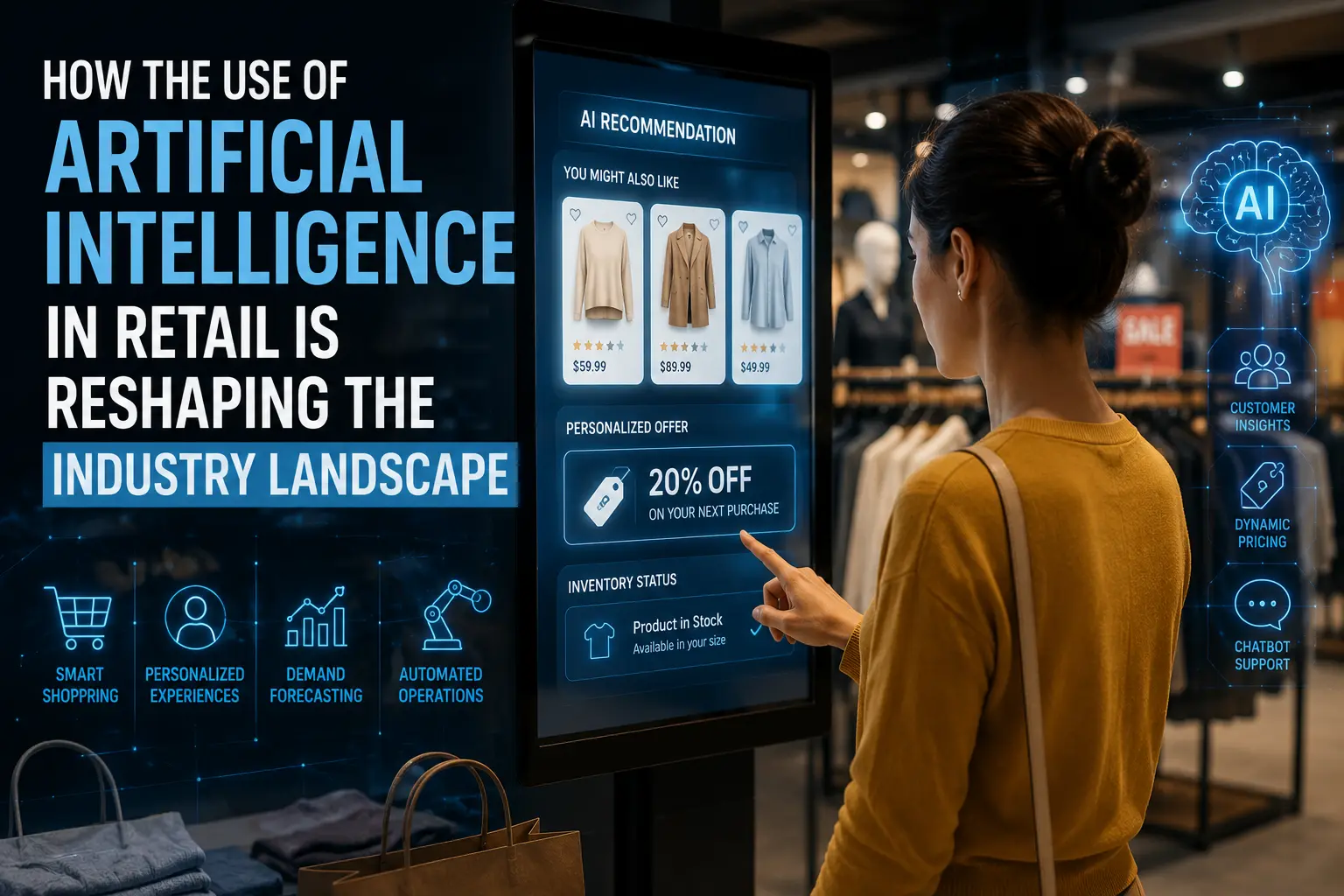
The retail industry has never been shy of adopting new technology. From barcodes back in the day to e-commerce today, it has faced constant changes in the business landscape. However, artificial intelligence (AI) is different. The use of AI in retail has, for the first time, started to make shopping decisions, or at least pre-filter buying options, on behalf of humans. Today, many consumers are simply asking questions to generative AI models like ChatGPT or Gemini and making their buying decisions right from there. And that’s just one of the many ways artificial intelligence has reshaped not just customer journeys but the business landscape as a whole.
This article gives you a glimpse of how retail companies have already adopted and implemented artificial intelligence across various use cases.
Artificial Intelligence Use Cases in Retail
The use of AI in the retail industry started with simple product recommendation engines and analytics. But the breadth of AI applications in the retail industry has moved well past that. Below are some examples of how retail companies are using artificial intelligence nowadays.
Frictionless Shopping and Checkout
A professional working with Wix in the eCommerce segment for about 2 years said in a Forbes interview that about two-thirds of all carts are abandoned. There could be multiple reasons behind this, including user friction, shopping behaviors, and website performance. This can lead to losses worth millions per annum.
Now imagine the same in offline experiences. Standing in queues after shopping is one of the biggest pain points of offline retail experiences. While cart abandonment is less common offline, checkout experiences still affect whether a consumer returns to your store or not.
In both these scenarios, Artificial Intelligence can offer a breakthrough to cope with these challenges, and here’s how:
AI for Online Checkout
Online retailers have been using auto-fill for a very long time now. Though it has helped reduce the time required to fill long checkout forms, the cart abandonment rate is still high. What artificial intelligence can do here is add to auto-fill by anticipating shipping preferences or choosing from different address and payment details based on historical details.
Apart from that, AI in retail can improve security and fraud detection. AI algorithms are capable of identifying and preventing fraudulent transactions. They can flag these transactions in real time to benefit both retailers and consumers. Dynamic pricing and real-time support at checkout are also areas where you can use this technology. Imagine using machine learning in retail to offer dynamic discounts at checkout based on historical data analysis. This would make consumers return to your online store for discounts carved out specifically for them based on their past purchases. Similarly, an AI-powered chatbot integrated on the checkout page can help solve any queries customers will have.
Retailers can even use conversational AI to assist shoppers throughout their purchase journey. Consumers can interact with these systems to compare products, get recommendations, purchase goods, track orders, and much more through both text- and voice-based conversations.
AI for Offline Checkout
Artificial intelligence is streamlining in-store checkouts by facilitating phygital stores. These stores blend physical space with digital tools to amplify customer experiences. For instance, retailers can use Internet of Things or RFID technology in combination with artificial intelligence. Common examples include smart shelves and smart carts. These shelves or carts can have RFID tags and IoT sensors to detect which products consumers have picked. Computer vision can also perform this activity to detect the items within a cart. After confirmation, these items can be included in the bill, and customers can simply pay through their smartphones to avoid waiting in queues.
Take, for example, Amazon’s Just Walk Out technology. It leverages AI, computer vision, and RFID. Consumers can simply walk out of the store after purchase and get a receipt online. They can pay the amount and even download the receipt through dedicated applications or a website.
At Climate Pledge Arena, we’re continuously looking to innovate and improve the in-arena experience for our fans. Amazon’s Just Walk Out technology with RFID allows for a fast and easy way for our fans to grab their favorite Kraken gear and get back to the game—and our fans loved the experience.
Todd Humphrey, senior vice president of digital innovation and fan experience for NHL’s Seattle Kraken.
Use of computer vision for checkout is on the rise. The global market for the same was valued at $10.8 billion in 2025 and is now estimated to reach $65.2 billion by 2034. This exhibits a compound annual growth rate (CAGR) of 22.4% during the forecast period.
Personalized Customer Experiences
There’s no denying that this is one of the most mature use cases of AI in shopping, not just in terms of implementation but also in terms of customer acceptance. It has a very long history, as personalization was among the first use cases that attracted a lot of businesses.
A Deloitte survey concluded that about 80% of respondents prefer companies offering personalized experiences. At the same time, a Boston Consulting Group survey of 23,000 people noted that about four-fifths of respondents were comfortable with receiving personalized experiences, and most of them demanded them. With 96% of consumers accepting personalization, India was right at the top of the list. It was followed by China, Brazil, and France, where 90%, 86%, and 82% of consumers accepted personalization, respectively. The trend is clear, as customers are demanding experiences unique to them, and the retail industry is no exception to that.
Product recommendation is the biggest example of AI-powered personalization in the retail industry. These recommendation engines use past data and machine learning algorithms to identify products to recommend. For example, say a retail brand offering pregnancy and baby products uses such a solution. In this case, suppose a woman purchased some pregnancy clothes about five or six months ago. Taking that into context, AI algorithms can recommend baby products for newborns.
Demand Forecasting
Retailers used demand forecasting traditionally through basic data analysis. However, that method is no longer efficient because of the growing economic uncertainty, market disruptions, and ever-changing consumer demands. AI-driven demand forecasting uses advanced neural networks and deep learning to make the whole process more efficient, faster, and accurate.
These algorithms process both past and real-time data for predictive analytics. Say there’s a national retail company with 800 offline stores, an eCommerce platform, and over 60,000 products. In this case, the AI system could incorporate the following data:
- Historical sales data dating back two or three years
- Supplier lead times
- Current inventory levels
- Weather forecasts
- Pricing changes
- Social media sentiment
- Website search trends
- Economic indicators
The AI system will process this data using machine learning models such as Gradient Boosting (XGBoost or LightGBM), Random Forests, Temporal Convolutional Networks (TCNs), Long Short-Term Memory (LSTM) neural networks, and Transformer-based forecasting architectures.
Now, say the retail company decides to run a promotional campaign for its wireless headphone product. The AI system detects that a similar campaign from last year increased demand by 40%. But it also found that the search for wireless headphones has increased by 65% in the last two months. Additionally, social media mentions have gone up significantly, and a competitor reported a product shortage last week. Based on this information, the AI solution won’t just suggest a uniform 40% stock increase. Instead, it will suggest something like a 70% increase in urban stores, a 45% increase in semi-urban stores, and only a 20% increase in rural stores.
AI in retail can offer such accurate demand forecasting so you can prepare not just for a rise or decline in product need but also manage your inventory levels beforehand. This lets you capitalize on opportunities as they arise.
McKinsey & Company, therefore, says that AI can reduce inventory levels by 20% to 30% through accurate demand forecasting. This can unlock 7% to 15% of additional capacity in warehouses.
Dynamic Pricing
Have you ever wondered why an airline ticket’s price keeps changing regularly? That’s because they keep changing the price based on demand, timing, and many other factors. This has helped airlines reduce empty seats while making the most out of every sale. The same method can be applied in retail stores, too. In fact, a popular statistic used for this concept is that Amazon changes the pricing of its products a record 2.5 million times every day. This comes down to price changes every 10 minutes across all its items.
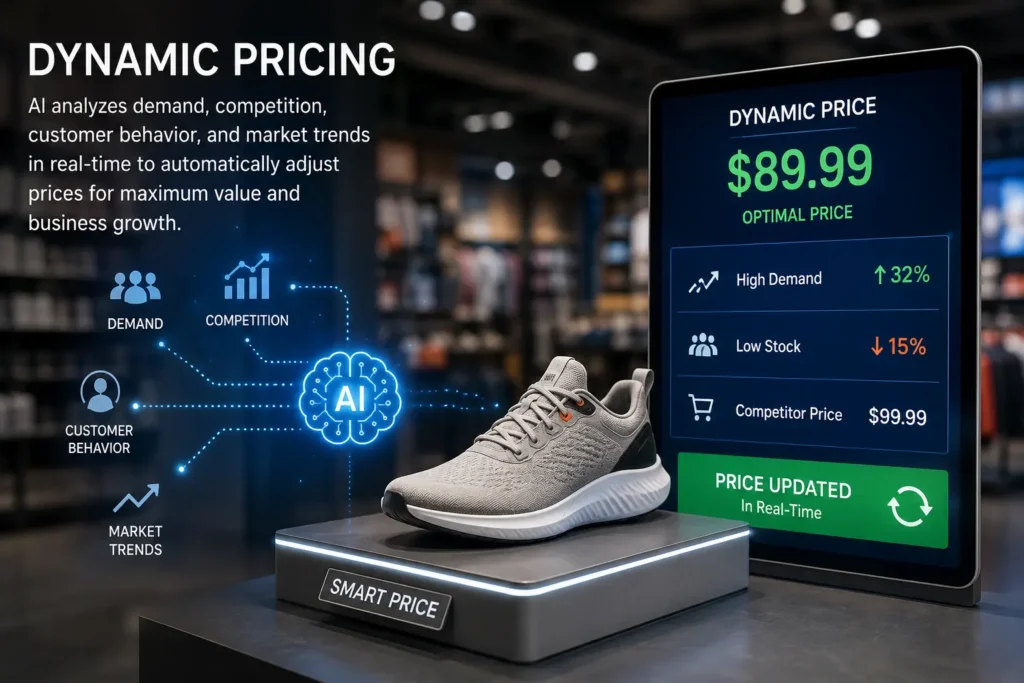
Artificial intelligence algorithms can take into account multiple factors, such as demand, competitor pricing, weather, inventory, expiry date, and more, to suggest the most ideal pricing for a product in real time. For instance, suppose you implemented AI for dynamic pricing at your clothing store. Now, say the AI solution is trying to find the right price for a sneaker. It detects that the weather is warm and there’s no indication of rain for a week or two. At the same time, demand for sneakers is increasing, and inventory is running low. Here, the system will suggest a higher price to capitalize on the opportunity.
In-Store Analytics
Your store can generate a significant amount of data every day. From foot traffic across different hours to dwell time by aisle, there’s a lot you can know if you have the infrastructure to collect and analyze in-store data. Put simply, demand forecasting and dynamic pricing are just two examples of in-store analytics. But the range of analysis doesn’t end just there. AI has the potential to analyze every retail data point your store captures and generate insights based on that.
A popular example of this is cross-selling and upselling. Both these strategies can do wonders for your bottom line if used correctly. Machine learning algorithms used for product recommendations can also help your store associates and workers with guiding customers to high-margin, trendy alternatives. They can even recommend products to consumers that they might not have considered buying because of a lack of knowledge.
Apart from that, the use of AI for in-store analytics can also support:
- Customer segmentation
- Product innovation
- Optimizing product lifecycle
- Consumer insights
- Retail assortment, etc.
Personalized Marketing
You can recommend unique products to different customers or even send marketing content on a first- or last-name basis. Regardless of that, you cannot personalize marketing efforts to individual customers. For instance, trying to write personalized emails for all consumers will only overwhelm you. Personalized marketing, therefore, requires segmenting customers into different groups, and that’s where artificial intelligence can be useful.
If you have consumer data, such as age group, location, gender, preferred language, etc., you can leverage an AI algorithm to create these groups. AI can then help create personalized marketing campaigns for these groups. The combination of AI-driven targeted promotions and generative AI can deliver the personalization you are seeking in marketing efforts.
Generative AI can brainstorm ideas and simplify the same concept for different customer segments so you can reach them across different touchpoints of their purchase journeys.
Waste Reduction
Behind the polished displays and organized shelves at retail stores lies a huge waste problem. Data shows that India wastes around 74 million tonnes of food annually. This represents a loss of ₹92,000 crores. A lot of this waste comes from grocery stores. AI is changing how retailers approach waste management and reduction in their stores.
To begin with, it reduces waste generation through demand forecasting, inventory management, and optimized supply chains. Even when waste is generated after this, the way it is collected and sorted is also changing. Internet of Things (IoT)-enabled smart bins can monitor fill levels, contamination rates, and more. This data can then be fed into AI systems to optimize segregation and waste management cycles.
Computer vision can also help sort out waste. It can identify and separate different materials with utmost accuracy. Thus, it can also come in handy if you want to recycle some materials.
Adaptive Interfaces
Have you heard of Google Research’s Natively Adaptive Interfaces (NAI)? The approach prioritizes user-centered design and embeds accessibility in multimodal AI agents. As a result, it creates interfaces that adapt to a wide range of user abilities and contexts. Now imagine this approach in the retail industry.
According to the World Health Organization (WHO), around 2.2 billion people worldwide face some form of near or distance vision impairment. Another study notes that 43 million people live with blindness, while 295 million have moderate-to-severe visual impairment. Businesses that don’t cater to this audience are losing a lot of revenue. With AI-powered adaptive interfaces, your online stores or eCommerce platforms can change their layouts in real-time to increase accessibility for such individuals.
In-Store and Delivery Robots
In-store AI robots can reduce overhead costs associated with staff. For example, they can scan shelves to identify out-of-stock items or detect pricing errors. Besides that, they can be helpful with cleaning, back-of-store order picking, and in-store assistance. This in-store assistance can serve both sides of the counter. You or your staff can use them for billing assistance or restocking items. On the other hand, consumers, especially the elderly, can use them to move their carts around.
Many retailers are also using AI-powered autonomous pods, drones, and self-driving vehicles for making last-mile deliveries. Considering that these last-mile deliveries can be very costly because of high labor costs and failed delivery attempts, autonomous vehicles (AVs) can save retailers a lot of money. Last-mile delivery is, therefore, a significant part of the future of autonomous vehicles.
The Growing Demand for AI in Retail in the Agentic Era
AI agents and agentic AI are now taking shopping experiences to a whole new level, as backed by Google’s data. Google processed 8.3 trillion tokens on Google Cloud Vertex AI for retail consumers alone in December 2024. By the end of 2025, that number increased to 90 trillion tokens per month. This shows an 11-times-plus increase year-over-year. He also introduced the Universal Commerce Protocol (UCP) for the era of agentic commerce at the National Retail Federation (NRF) 2026, Retail’s Big Show.
“When we do get this right, shoppers will be able to find exactly what they’re looking for, get inspired by new ideas and transact more easily than ever before.”
Sundar Pichai, CEO of Google and Alphabet, said at NRF 2026 in New York.
The platform is open, agnostic, and built in collaboration with retail industry leaders, such as Target, Walmart, Shopify, Etsy, and more.
That’s just the start of the storm that the agentic AI era will bring, and its demand is on the rise because of:
- The emergence of the channel-agnostic store
- Expansion of omnichannel shopping
- Growth driven by premiumization
- Rising consumer buying power, especially among the Gen Z population
However, this also causes a strain on the environment because the data centers running these AI agent models consume a lot of energy, require water for cooling, and produce significant e-waste. The key will be to find a balance between artificial intelligence use cases in retail and its carbon footprint.
The Future of AI in Retail
AI in retail has already found a lot of use cases throughout the business landscape. From personalization and analysis to demand forecasting and robots, there’s a lot that artificial intelligence can offer. However, how much you succeed with this technology depends a lot on infrastructure preparedness. It is essential throughout the process, right from gathering data efficiently to analyzing it for insight generation.
Now, with the advent of agentic AI in retail, the penetration will only grow further. For now, most AI is used for business operations or streamlining the customer journey. But consumers may soon start to use it themselves by allowing AI agents to shop for them.
Frequently Asked Questions
AI in retail can help with both cost reduction and revenue generation. For the former, it can play a significant role in waste reduction and inventory management, both of which can save a lot of money for retailers. As for the latter, cross-selling, reselling, personalization, dynamic pricing, and a lot more can be utilized to attract customers and drive revenue.
Dynamic pricing considers factors like inventory levels, demand, weather, competitor pricing, etc. Since it takes into account market conditions and changes pricing accordingly, it is largely legal. Surveillance pricing, on the other hand, is about changing costs for individual customers based on their personal data. Therefore, it is currently facing a lot of scrutiny worldwide. For instance, New Jersey recently passed a bill to ban it and make it punishable under consumer fraud.
AI agents can make recommendations, fill out checkout forms, and make purchase decisions on behalf of customers to assist them in shopping. While they are capable of making decisions, they are currently playing the role of assistants rather than decision-makers. The final decision always falls upon the consumer, whether they want to buy something or not.