What is Retrieval-Augmented Generation (RAG)? Meaning, How It Works, Benefits & More

If you have used a generative artificial intelligence (AI) tool, you would have read a warning on every chat you have had with it. The most popular GenAI tool, ChatGPT, says, “ChatGPT can make mistakes. Check important info.” Similarly, Claude’s chat screens say, “Claude is AI and can make mistakes. Please double-check responses.” These warnings stem from what’s called “hallucination,” which Retrieval-Augmented Generation (RAG) can minimize.
Hallucination is the biggest challenge facing large language models (LLMs) and the generative AI tools they power. It is the phenomenon where LLMs generate false, fabricated, or misleading information but present it as a confident response.
Research published on arXiv.org reached an interesting conclusion. The study analyzed 172 billion tokens across different temperatures, context lengths (32K, 128K, and 200K tokens), and hardware platforms (NVIDIA H200, AMD MI300X, and Intel Gaudi 3). The conclusion was that even the best-performing models fabricated responses. The fabrication rate increased with context lengths. At 32K, the rate was 1.19%; it almost tripled at 128K; and reached over 10% at 200K.
This points to a growing need to minimize generative AI hallucinations for more accurate and factual responses. The solution is Retrieval-Augmented Generation. But how? Let’s find out.
What Is Retrieval-Augmented Generation (RAG)?
Retrieval-Augmented Generation (RAG) is an AI architecture that connects LLMs to external knowledge bases. The result is a more relevant, accurate, higher-quality response.
Think of it as a framework that helps overcome this limitation. LLMs that power generative AI models are trained on large datasets. They refer to these datasets alone to generate outputs. But when you ask it something not present in these datasets, it will rarely tell you it doesn’t have the required information. Instead, it generates a factually incorrect response and presents it with full confidence. This phenomenon is referred to as hallucination.
Besides providing wrong information, these hallucinations can have more severe indirect consequences. For example, if a generative AI model gives wrong financial advice or details about a disease, it could have real-life consequences. In fact, artificial intelligence hallucinations even triggered military operations recently.
CNN reported that during the Middle East war, a US analyst ran signals of a Chinese vessel in a chatbot for analysis. The analyst then used the chatbot again to summarize the details and create a report. Because of a hallucination, the chatbot identified the content within the vessel as part of a nuclear weapons program. The military was all set to start an operation to intercept the vessel. But higher officials reviewed the report before proceeding and found it was AI-generated and incorrect.
As RAG connects these AI models with updated, external sources, the knowledge base grows. As a result, LLMs can produce more relevant responses without hallucinating.
Components of Retrieval-Augmented Generation Architecture
An RAG system features a wide range of components. The first four listed below are the primary components, while the rest are important too:
External Knowledge Base
RAG’s core task is to connect LLMs with external knowledge sources. So, creating a queryable knowledge base is the foundational and first stage. This can be data repositories from various sources, such as websites, PDFs, documents, audio & video files, etc.
Text Chunking and Vectorization
Since the data comes from external sources, most of it is unstructured and unlabeled. Retrieval-Augmented Generation system overcomes this issue through embeddings. Embedding turns data into vectors (numerical representations). In this process, data points that are relevant to and associated with each other are placed close together.
While this makes recent, updated knowledge accessible to LLMs, it doesn’t necessarily solve the entire problem. LLMs will still be limited by contextual data. If it loses the context while retrieving information from an external knowledge base, there’s no point in having a RAG architecture. Therefore, it is important to ensure embeddings don’t overwhelm the LLM’s context window, which is done by chunking data into smaller pieces.
Retriever
Vectorizing data makes the external knowledge base ready for semantic vector search. This lets machine learning algorithms scan massive datasets quickly and find relevant information to generate responses.
The retriever, or the retrieval model, then transforms user queries into embeddings. It then searches the entire knowledge base for similar embeddings. Once it retrieves the required embeddings, the system turns them into human language in the output.
Integration Layer
This layer is what connects the entire architecture. It passes data around the network within the RAG system so all other components can complete their designated processes. Based on these processes, the architecture creates a new prompt that includes the original query and the embedding information returned by the retriever. This is done through various prompt engineering techniques.
Generator
The generator creates the final output based on the prompt from the integration layer.
Types of RAGs
While there are no set types of artificial intelligence retrieval-augmented generation systems, you can broadly classify them into three different architectures. The classification depends on how they organize, connect, and retrieve data.
- Vector-Based RAG: The RAG turns externally sourced data into a vector database.
- Knowledge Graphs: Here, data is organized around nodes and relationships so RAG AI can draw connections between them.
- Ensemble RAG: The architecture runs multiple retrievers simultaneously, then combines the results. This lets the system cross-check each retriever’s responses to generate the most accurate output.
How Does Retrieval-Augmented Generation Work
Retrieval-Augmented Generation works in two phases: ingestion and retrieval. As the components section gives away, ingestion is where the system accesses external data and vectorizes it. The retrieval phase brings together the most relevant embeddings and uses them to generate responses.
Put simply, RAG combines information from content generation models with retrieval models to produce more accurate, authoritative responses. The key here is the additional context provided by external sources.
An LLM connects with these external knowledge banks in different ways, such as database queries (from existing databases), Application Programming Interfaces (APIs connected to other platforms that hold the required information), and web search (scraping web pages, especially news sites, for relevant information.
Once the RAG architecture connects the LLM to external sources, it chunks the data into embeddings and stores them in a vector database.
When a user inputs a query, the retrieval model runs it through the vector database to find relevant embeddings and then generates an output based on that additional information.
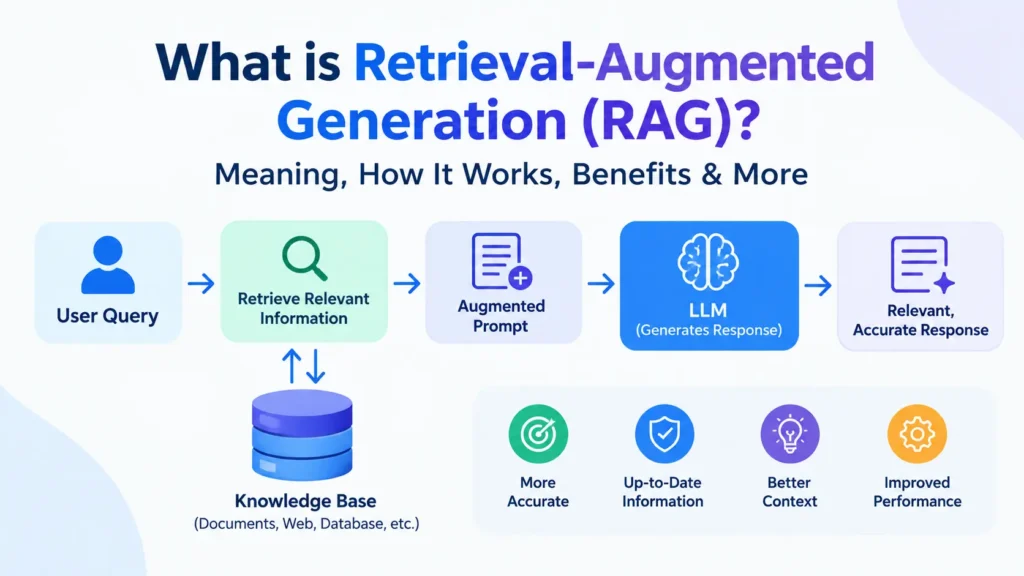
It can be divided into five simple steps:
- User asks a query
- The retrieval model runs the query to get relevant embeddings
- Contextual information within these embeddings is sent back to the integration layer
- The RAG system creates a new augmented prompt, which also includes the additional information retrieved from external sources
- The LLM generates a response and sends it back to the user
Let’s consider an example of a university librarian to understand this. The librarian manages a library with thousands of books, research papers, student guides, and more. Students come to the librarian with a wide range of questions. But answering all of them and finding the right book could be stressful and challenging.
So, the librarian decides to use an RAG-powered LLM system that can assess all available resources, find the best options, suggest the ideal match, give an accurate response, and reduce the time it takes to do all this.
Now, suppose a student comes to the librarian and asks for resources to help reduce exam stress and improve concentration. Here, the system will first convert all resources into embeddings. It will chunk relevant resources into embeddings, such as “techniques for managing exam anxiety” or “ways to stay calm before a test.”
While these embeddings use different words, the content within them could be similar. The chunking process is, therefore, important because it brings all associated resources together without dismissing any option.

The system will then retrieve tips from all resources. Thus, it may retrieve resources with sections like breathing exercises for anxiety, sleep habits that support concentration, study schedules, and more. The architecture then adds this retrieved information to the prompt for more context. The LLM will then generate a response with collective tips from various resources. It could also suggest the best books that cover most of these tips.
How RAG Empowers LLMs
Standalone large language models have many limitations. To begin with, they have limited access to knowledge. Because they rely only on their training data, they can’t access real-time information for queries about recently concluded events.
This lack of access to recent knowledge can cause them to hallucinate and produce inaccurate results. They will simply predict and generate responses that look right based on the patterns they have analyzed and formed. But those results may not necessarily be true.
They also lack specificity. While most LLMs can handle general knowledge well, they struggle with prompts and queries in highly specific niches. For that, they need access to external resources that are specific to those niches.
LLMs also struggle with limited context because their training data may not include all the information they need to answer consumers’ queries. Training generative AI models can be extremely time-consuming and can have a significant environmental impact. Therefore, most businesses focus on training data quality rather than quantity. As a result, a general LLM may not know many concepts.
The retrieval-augmented generation framework helps LLMs address these shortcomings. By assessing external resources, creating chunks, embedding them, and retrieving relevant information, RAG improves LLMs’ contextual understanding. This contextual enrichment enables more precise query comprehension and better replies.
This further improves response coherence. With additional context, the LLM can maintain logical flow and consistency with the query. Put simply, this improves accuracy and makes an LLM more trustworthy and credible.
Benefits of Using RAG
So far, we have learned that RAG enhances LLM outputs. But it offers many more benefits to businesses and the end users, too. Below are some advantages of using RAG.
Cost-Efficient Implementation
Training general large language models has a lot of downsides. Beyond the environmental impact, it can be time-consuming and costly, both of which directly affect a business’s bottom line. Without RAG, companies have no option but to keep training LLMs on small, updated chunks of information. Otherwise, the AI model will have a knowledge cutoff that will slowly make the generative AI platform obsolete.
However, retrieval-augmented generation simplifies the process by making recent, relevant data readily available through external sources. As a result, engineers can improve responses without retraining models on new data repeatedly.
Scale to Domain-Specific Data
There are several domain-specific LLMs. Take, for example, BloombergGPT, which was trained specifically on a large set of financial data and news.
“For all the reasons generative LLMs are attractive – few-shot learning, text generation, conversational systems, etc. – we see tremendous value in having developed the first LLM focused on the financial domain.”
Said Shawn Edwards, Bloomberg’s Chief Technology Officer.
Similarly, there’s BioGPT (biomedical), Predictice (legal), Med-PaLM 2 (medical), and much more.
Most of these domain-specific models are first trained on general datasets and then on domain-specific knowledge. The problem here is the additional step, which adds to the downsides of training LLMs.
RAG enables large language models to stay relevant with industry-specific knowledge without further training. Moreover, it can connect a generative AI model with social media feeds via an application programming interface (API) for real-time updates on any domain.
Low AI Hallucination Chances
The core task of any artificial intelligence model is to find patterns and make predictions based on them. Generative artificial intelligence models work similarly.
They will find patterns in training data and then predict the most relevant response. But when they don’t have the information to give an output, they start detecting patterns that don’t exist. Then, they create a response based on these non-existent patterns and present it as authoritative and factual. This phenomenon is known as artificial intelligence hallucination.
RAG provides access to current data. Accurate information helps ensure that more LLM outputs are reliable. This does not necessarily mean that there will be no hallucination when you use RAG, but it reduces the chances.
Increased User Trust
As hallucinations decrease and responses become more accurate, trust increases. Moreover, retrieval-augmented generation architecture can add citations to the external knowledge sources. At first, users can cross-check the information against the original source. Over time, users will start trusting the generative AI model more.
More Developer Control
Developers have the same control over LLM training until the initial launch. But once a platform launches, adjusting datasets becomes more complex. RAG, however, enables more developer control by simplifying data pipeline construction.
For instance, turning a general GPT model like ChatGPT into a domain-specific model requires further training. Similarly, if the developer decides to change the domain later, they will need more training and fine-tuning.
But with RAG, developers and data scientists can easily change the external data source. This makes it easier to reposition the model for another task.
Retrieval-Augmented Generation Use Cases
You can leverage RAG’s benefits across multiple use cases. Here’s a list of some of the key applications of RAG:
- Generative AI: RAG’s ability to provide access to real-time information improves generative AI’s responses.
- Conversational chatbots & virtual assistants: Many businesses are using conversational AI to empower their customer support teams. They can use RAG to train these platforms with business and industry-specific knowledge for improved experiences.
- Research: RAG lets LLMs read external sources, documents, and other media. This makes them especially good at research since they can also cite sources. For example, a healthcare professional can get a RAG-powered LLM to read and understand a patient’s medical history.
- Recommendation services: RAG architecture can connect a user’s historical behavior with up-to-date offers, products, and services. This added context makes it good at recommending products or services.
- Customer relationships: Employees can access real-time customer information from a customer relationship management (CRM) tool using RAG. With access to updated customer information, employees can use RAG-powered LLMs for personalization.
Instead of relying only on what they learned during training, large language models can pull relevant, up-to-date information from trusted external sources with retrieval-augmented generation (RAG). This directly affects how LLMs deliver answers. The result is an output that is more accurate, more current, and grounded in real data.
Because AI needs to stay reliable without the cost of constant retraining, RAG stands out as one of the most effective options. Whether you are building a chatbot, an internal knowledge assistant, or a research tool, it gives your model the context it needs to respond with confidence.
Frequently Asked Questions
Fine-tuning changes an AI model’s internal weights. While this improves response quality, it can be expensive and time-consuming. RAG, by contrast, leaves the model unchanged and supplies new information at query time.
RAG-enhanced LLMs generate responses that are grounded in updated information. This can significantly reduce hallucinations, but it does not eliminate them completely because challenges like poor retrieval quality, outdated sources, or the model misreading the retrieved context can still lead to errors.
RAG can work with many sources, including PDFs, internal documents, databases, websites, knowledge bases, and APIs.
RAG is suitable for small businesses since they don’t have enough resources to train an LLM from scratch. So, they can use an open-source LLM and train it on company- or industry-specific data with the help of RAG.
Common challenges include maintaining data quality, choosing the right chunking and retrieval strategy, managing latency, and ensuring sensitive information is properly secured and access-controlled.