How Is the FIFA World Cup 2026 Using Artificial Intelligence

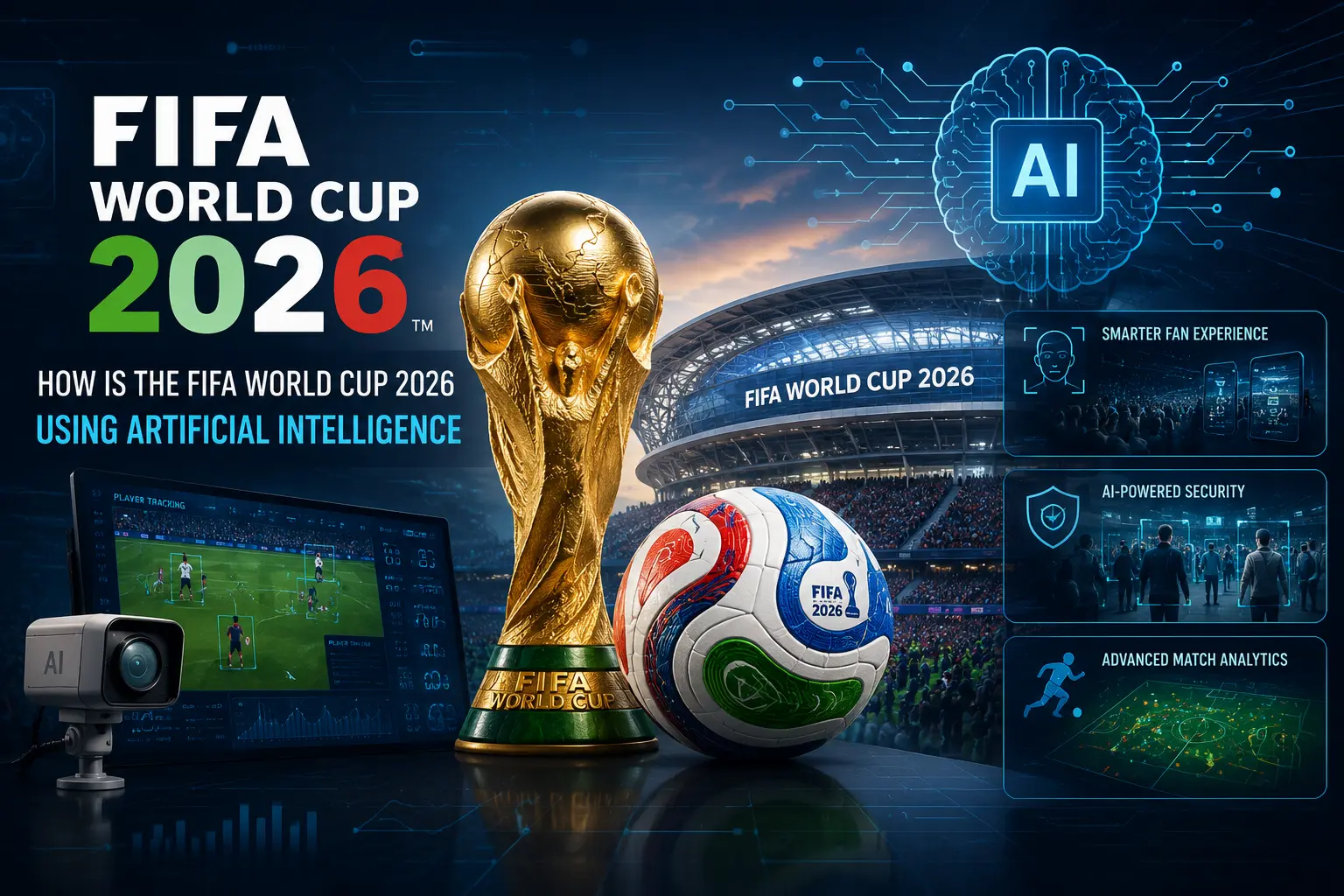
Did you know that many artificial intelligence (AI) algorithms predicted that France would be the winning team in the FIFA World Cup 2026? So, when Spain defeated France to enter the final, it proved many artificial intelligence algorithms wrong. But that’s how sports matches are. They are unpredictable and can go in anyone’s favor. But while AI failed at this prediction, it is making waves in overall use at the tournament. The use of AI in the FIFA World Cup 2026 has helped not only referees and teams but analysts and fans, too, and that was the goal of Lenovo, the official technology partner of the event.
“From referees and teams to analysts and fans, you need to be respectful and bring everyone along to help increase the chances of success.”
Arthur Hu, Lenovo’s SVP, Global CIO and SSG Chief Delivery & Technology Officer
The question here is: why is the biggest sporting event in the world, comprising 48 countries and 104 matches hosted by 16 cities across three different countries, using such a massive AI infrastructure? Actually, there’s a very straightforward answer to this. Artificial intelligence is being used because it can streamline the end-to-end operations of the tournament. Here’s how:
Use of AI in the FIFA World Cup 2026 for Officiating
The most visible use of AI in the FIFA World Cup is through Semi-Automated Offside Technology (SAOT). It is an AI-powered technology that helps the Video Assistant Referee (VAR) make accurate decisions, especially for offside.
Offside decisions can directly affect the end result. Take, for example, the Argentina vs. Saudi Arabia group stage match from 2022. Argentine footballer Lautaro Martínez scored in the match, but the goal was disallowed because of offside. This led to Argentina’s shocking 2-1 loss against Saudi Arabia. While the team went on to win the FIFA World Cup 2022, the decision remains heavily disputed by fans.
SAOT minimizes the chances of such controversial decisions. It combines data from three sources:
- 16 optical tracking cameras that are installed in every hosting stadium
- A connected adidas Trionda match ball carrying a motion sensor, which records movement 500 times every second
- Full 3D body scans of every one of the 1,248 players at the tournament (new for 2026)
The fusion of this data allows the system to flag close calls. A VAR then makes the final decisions based on human judgment. What artificial intelligence does is that, instead of sending every signal for VAR review, it directly sends automated audio into linemen’s earpieces if there is a clear offside.
Each match now generates 150 million tracking data points. All this data is fed into an AI system that is built on Hawk-Eye’s optical tracking layer and Lenovo’s processing infrastructure.
AI for Team Preparation
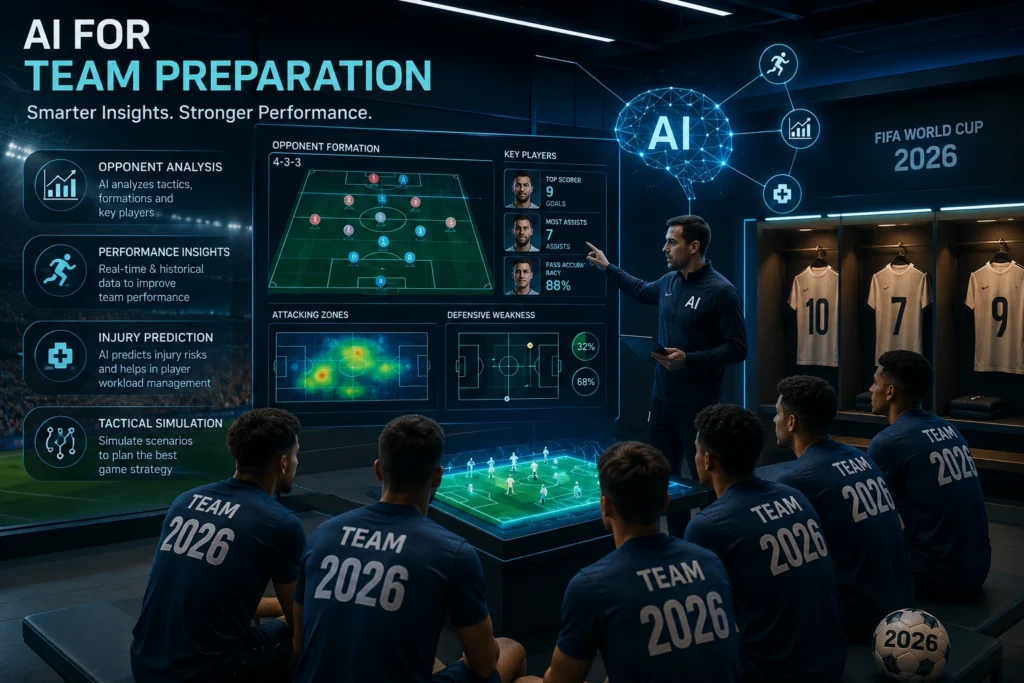
Another key reason for using AI in football is to close the growing gap between federations. Some wealthy federations have all the resources they need to pull out data and use it for better preparation. Artificial intelligence is closing this gap through Football AI Pro.
It is a free generative AI assistant that the management has given to all 48 qualified teams. It’s built on what FIFA calls a “Football Language Model.” Trained on millions of match data points, it lets coaching staff ask questions about upcoming opponents. The system understands queries and generates appropriate results using Natural Language Processing (NLP). It can give text reports, video clips, statistical graphs, and 3D match reconstructions covering more than 2,000 performance metrics.
However, it would be wrong to say that Football AI Pro has completely closed the gap between different teams and federations. For instance, the Football Association of England has its own team of data scientists and analysts that smaller countries might not have. Similarly, Argentina, Brazil, and France have all separately partnered with Google to use its Gemini platform for performance analysis, formation evaluation, and opponent-tendency modeling.
While this is not something most smaller nations can afford in their budget, they are finding their own workarounds for using artificial intelligence. Curaçao’s federation, for example, used AI-assisted geospatial data to track players of Curaçaoan descent scattered across the Netherlands. This helped it identify eligible talent and route scouts accordingly. Thanks to that, Curaçao, a Caribbean territory of only about 159,000 people, became the smallest nation ever to qualify for a World Cup.
AI for Stadium Security and Operations
Stadium security and streamlined operations are also areas that are using AI in the FIFA World Cup. A classic example of this is the use of an AI-powered facial recognition system that allows registered fans to enter stadiums without the need for a physical ticket. Gillette Stadium in Boston, Hard Rock Stadium in Miami, Mercedes-Benz Stadium in Atlanta, and many others are using this system at entry points.
There’s much more. An Intelligent Command Center is monitoring crowd density at all 16 venues simultaneously. The goal here is to flag any potential issue before it escalates. Then there are Boston Dynamics’ quadruped robots. They are patrolling restricted areas and stadium perimeters at select venues in the US and Mexico.
The Guardian reported that FIFA is also using AI to curb footballers’ exposure to abuse. An ITV survey found that one in three footballers struggle with mental health issues because of online abuse. The AI system aims to help prevent this. It filters out abusive and offensive comments so that players don’t have to face them. However, the system only works on Facebook, Instagram, YouTube, and TikTok. It does not work on Elon Musk’s X.
AI in the FIFA World Cup Broadcasting
For viewers like you and me, artificial intelligence is helping with the tournament’s broadcasting. Computer vision is helping to automate camera direction so that they always track the ball.
The 3D player avatars created for SAOT are also being used to amplify broadcast replays. This makes it easier and clearer for the audience to know which footballers were involved in a contested call.
Since FIFA is undeniably the biggest sporting event reaching billions of fans globally, Google is also playing its part to improve the fan experience. The World Cup has driven Google Search queries to record highs.
Google Search broke all prior usage records and saw its highest usage in history right after Argentina scored their winning goal in yesterday’s match! 🤯 Great to see the global excitement for the World Cup… can’t wait for the semis and final!
Nick Fox, head of Google’s Knowledge and Information unit wrote in an X post on July 8, 2026.
Therefore, the company has built AI-generated summaries and real-time statistics directly into football-related search results during the tournament.
The Most AI-Driven World Cup Ever
Artificial intelligence has already become a key part of many sporting events. However, the FIFA World Cup 2026 has shown that AI can improve every aspect of the game. Referees, teams, players, and fans are all benefiting in some way or another. But it is important to remember that AI has its limitations, too. With the advent of AI agents and agentic AI, the use of artificial intelligence in upcoming tournaments across all sports can grow further.
But it is also important to remember that AI has its limitations, too. For instance, AI systems leverage a lot of data that needs to be stored and used both securely and ethically. Apart from that, AI predictions aren’t always accurate, especially in sports, where humans are the ones controlling the ball. Upsets, last-minute goals, tactical brilliance, and individual moments of magic are still beyond the reach of any algorithm. France’s exit despite being widely backed by AI predictions is a perfect example of that.
The benefits of using AI in the FIFA World Cup 2026 and other sporting events certainly outweigh the limitations or any disadvantages. It will continue to be an assistant for the management team rather than coming into the spotlight itself, so the focus is always on the sport played.
Frequently Asked Questions
The Football AI Pro platform gives all national teams a shared baseline, but their access to AI tools is still not equal. Based on their resources and budgets, teams can have a wide range of analytics teams and can be using other AI tools in addition to Football AI Pro.
It can vary from country to country and stadium to stadium. Brazil, for example, passed a 2025 law mandating biometric access at larger stadiums. Mexico has moved toward permanent digitized biometric entry. Similarly, many stadiums and countries are using AI security systems in their own way. It’s not like these artificial intelligence security systems were created specifically for the FIFA World Cup. They were in use before that and will continue to be in use once the tournament ends.
It can make officiating faster, but that’s not the goal of these algorithms or FIFA. The aim is to make officiating much more accurate rather than fast. AI provides additional data inputs and insights that make things clearer for referees and assist them in making the final call.