Agentic AI Readiness: How to Assess and Prepare Your Organization for Agentic AI Deployment


The nature of how work gets done is changing, and it is all thanks to artificial intelligence (AI). Many businesses have already successfully automated repetitive tasks and analyzed massive datasets to generate relevant insights using this technology. However, the future belongs to agentic AI. Imagine that the chatbot you have deployed for customer support can also make decisions to issue refunds, coordinate with inventory systems, or escalate unusual cases. That’s the promise of agentic AI, as it allows artificial intelligence systems to coordinate with other AI solutions and make decisions on behalf of users. Agentic AI readiness ensures your business is ready to facilitate these systems.
This hype is reflected in the numbers, too. Gartner predicts that 60% of brands will use agentic AI to streamline one-to-one interactions by 2028. Similarly, a Deloitte survey found that 80% of Indian organizations are exploring the uses of autonomous agents. It also notes what the key is to unlocking the potential of this technology.
As Indian organisations explore Agentic and GenAI, the key to unlocking their potential lies in moving from experimentation to large-scale deployment
Ensuring the success of large-scale deployment comes down to complete preparedness, and that’s where agentic AI readiness comes in. It is a method for identifying potential gaps that could derail an agentic AI project. With the right agentic AI assessment framework, you can proactively mitigate the problems before deploying a system.
But before getting into that, let’s understand the opportunity agentic artificial intelligence brings.
The Agentic AI Opportunity
While many people use AI agents and agentic AI interchangeably, they are not one and the same. When given a goal, AI agents can pursue it with a degree of autonomy. This includes gathering information, processing it, and then making a decision. When multiple AI agents work together to complete a complex task, they are referred to as agentic AI. However, that does not mean a single AI agent cannot become agentic.
Thanks to its huge potential, adoption is increasing rapidly. Databricks’ State of AI Agents report claims that agentic AI use grew by 327% in less than four months. Some of the key drivers behind this growth are:
- Enhancing customer experience
- Reducing costs
- Business differentiator
- Better regulatory compliance
- Accelerating revenue
- Managing workforce shortages
A significant opportunity that agentic AI brings into the picture is orchestrating digitalization. Earlier, digitalization was the one big thing that gave companies a significant competitive advantage. Moving from paper to digital records or implementing basic automation meant streamlining customer experience and operational efficiency. But with almost every small and large company now digitized in at least some form, that’s no longer the case. Now, the differentiation lies in how these digitalized processes communicate with each other. Since agentic AI can plan, decide, and act, it can orchestrate all these solutions to pursue goals autonomously.
Yet, the challenge lies in where to begin and how to scale. A lack of process understanding or unclear business value could lead to failures. It’s all a part of assessing agentic AI readiness.
Agentic AI Readiness Assessment
Checking for AI agent readiness is to ensure your business has the capabilities to implement and run agentic AI systems. By evaluating the core readiness of business infrastructure and governance, this framework helps identify where AI agents can be deployed and where the risks outweigh the benefits.
Whether you just want to check if your organization is ready to implement agentic AI solutions or to deploy them, readiness assessment is the baseline. You can proceed to successful implementation and growth only once you know where you currently stand.
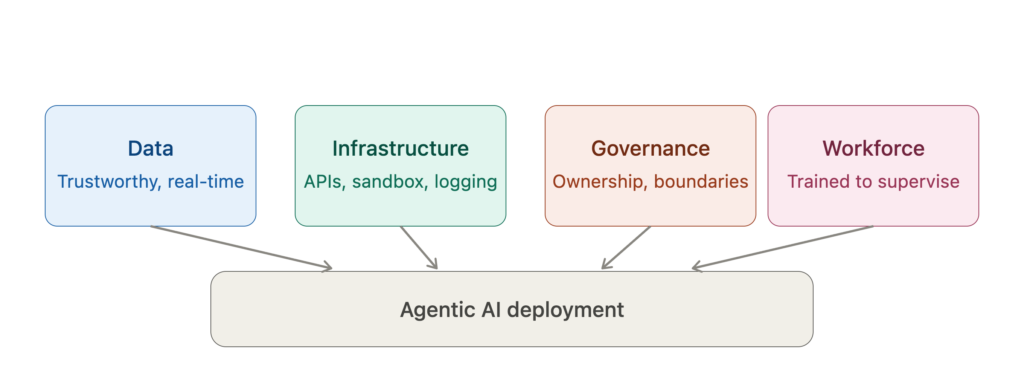
Data Readiness
Agentic AI can plan, decide, and act, but to do so, it needs the right data. It’s not that you cannot deploy these systems without appropriate data. However, the thing is that AI agents communicate with each other to complete complex tasks in a truly agentic AI manner. But if they don’t have a reliable, shared view of the underlying data, they will start making conflicting decisions, repeating work, or repeatedly triggering each other. This results in an uncoordinated, infinite loop.
Data readiness, therefore, is one of the most important factors to consider before deploying agentic AI.
“The data exists within our organization, but organizing it—determining its timeliness and relevance—remains our greatest challenge before we can fully leverage AI.”
Yuichi Osawa, Vice President, Head of S&OP, Honda Motor Co., Ltd told IBM.
Put simply, data is no longer limited to just detecting patterns or feeding predictions. Instead, it is now the continuous fuel stream that powers the autonomous actions taken by agentic AI systems. Take, for example, an inventory and a purchasing agent working together. Now, suppose the inventory agent lacks accurate, real-time data. In this case, the purchasing agent will over-order massive quantities.
There are a few things you can do to make your data ready for agentic AI implementation, such as improving:
- Data infrastructure, including hardware, software, networks, and analytics tools
- Security and privacy of data
- Cleanliness and quality of the data
- Data integration
Your organization should have the right data, and it should be clean and protected from cybersecurity threats. Apart from that, the infrastructure should allow data centralization so each AI agent can connect with a single source of accurate information to plan, decide, and act autonomously. However, only 19% of the 1,920 COOs or CSCOs across 33 geographies surveyed by IBM say that their organization has the data infrastructure to scale data integration across all functions.
Once data is unified, it should also allow AI agents to learn and improve over time. That’s the only way to make the agentic AI system good at what you intend it to do. This means real-time data availability and embedded governance in access control.
Agentic AI Infrastructure
While we already discussed data infrastructure in the above section, there’s a lot more agentic AI infrastructure readiness requires besides just letting data flow.
Traditional AI systems can rely on a single database or data source and complete basic functions based on that. Generative AI requires a much more robust infrastructure for handling multimodal capabilities across text, audio, and video. Autonomous agents, on the other hand, require something different and more complex. Although they rely on the same large language models as generative AI, they seek dynamic interaction and real-time information exchange. The architecture should be built to facilitate orchestration so agents can communicate autonomously.
While data interoperability and orchestration are the most important, agentic AI-ready infrastructure should be scalable and flexible. The basic way to have both of these is through cloud infrastructure. Although on-premises infrastructure gives you more security and control over the agentic AI system, it is not scalable. Cloud computing lets you run heavier and lighter models simultaneously based on AI agents’ requirements.
Agentic AI Governance
Because AI agents within agentic AI work autonomously, governance is fundamental. That’s because, despite all the benefits, agentic AI without governance is like a double-edged sword. It can lead to legal, ethical, and operational issues. Say, for example, a retailer is using artificial intelligence for dynamic pricing. Implementing agentic AI in this situation may result in the system changing pricing for every individual, and that’s not an ethical practice.
Agentic AI governance readiness here means having a clear view of what decisions you want AI agents to make on their own and where you want them to have human-in-the-loop. The ideal option is to give them autonomy to a certain level where it does not impact ethics, result in legal consequences, or involve a large amount of money. For instance, allow them to give refunds of up to $100 after evaluation, but if the amount exceeds that, ask them to escalate the query to a human.
Currently, AI agents are scaling faster than their guardrails. However, 21% of respondents in a Deloitte survey say that having mature governance is essential to manage agentic AI risks.
Some questions you should ask to assess governance readiness are:
- Is there a clear owner for each agent’s decisions? (Someone who monitors its use regularly and understands how it operates)
- Are there defined boundaries the agent cannot cross without human approval?
- Is there a review and audit process?
- Does your governance structure account for regulatory exposure in your industry?
Based on the answers you get for these questions, create strategies and fine-tune them unless you get positive answers for all of them. Once all the answers become yes, you will be ready to at least start deploying agentic AI.
Workforce Readiness
The last piece of assessment is to check if your workforce is ready to work with agentic AI. You may encounter two challenges here. One is over-reliance, where your workers will try to use agentic AI for everything, even if the intended purpose is not to do so. The result is that it will reduce their ability to intervene when human judgment is needed. The second challenge is resistance to change, which leads to slow adoption and a lack of trust in agentic systems.
You must invest time and resources in employee training and transparent communication to get your workforce ready. Apart from that, it is also advised to get them involved in the agentic AI design process so they can trust and transition to its use smoothly.
The advent of agentic AI, or rather artificial intelligence as a whole, has also changed roles and responsibilities. Earlier, many feared that AI adoption meant reduced jobs, but that perception has changed significantly. Many analysts predicted that AI would create more jobs than it eradicates, and that’s turning out to be true. However, workers need to learn the skills to work alongside AI systems.
You must also align human-AI collaboration with business outcomes. When it is directly tied to KPIs and business goals, humans and agents will work towards shared outcomes, and this means that every decision taken will offer business value.
Agentic AI Readiness Benchmark
Based on the readiness assessments from above, you can identify where you sit on the maturity curve.
| Level | Data | Infrastructure | Governance | Workforce |
| Ad hoc | Scattered, inconsistent | Manual, UI-only access | No clear ownership | Unaware or anxious |
| Reactive | Centralized but unreliable | Some APIs, no sandbox | Ownership exists, undocumented | Aware, untrained |
| Managed | Trusted, real-time | APIs + testing environment | Clear boundaries and audit trail | Trained, actively supervising |
| Optimized | Trusted + continuously validated | Full observability, safe rollback | Boundaries adapt as agents prove reliability | Roles redesigned around agent oversight |
Most organizations aren’t at the “Optimized” level across all four pillars of readiness assessment. But the need for assessment is not to fall in that category. It is about finding your weakest link and working on it to reach the “Optimized” level.
Agentic AI Deployment Framework
Once you assess your readiness for agentic AI, the next step is to deploy a system to start gaining benefits. While this process can be divided into multiple steps, here’s the basic idea of how to prepare for agentic AI systems:
Detecting Implementation Areas for Agentic AI
After assessing where you stand and making all the changes to get ready for agentic artificial intelligence implementation, the next question is where to deploy. Now, this does not involve only deciding where to implement agentic AI and where not to; it is also about where to implement agentic AI instead of traditional AI systems. For example, a basic, well-defined, and repetitive task may not require the complexity of agentic AI.
A key practice to help you with this is task mining. Task mining is analyzing how work actually happens rather than relying on how a process is documented on paper. This means observing system logs, click paths, and time spent. This practice surfaces the gap between the documented workflow and the real one, which helps determine which functions are the right fit for agentic AI.
Go for tasks that are high volume, rule-governed but not perfectly documented, and do not have high error consequences.
Sequence Implementation
If you try to pursue every high agentic AI readiness function at once, all you will do is overwhelm yourself and your team. Starting small and scaling has been the golden rule for implementing new technologies for ages, and you need to follow the same. But to understand which function to pursue first is what sequencing is all about.
Start by focusing on high-readiness functions with very low complexity. This will build understanding, capability, and trust, all of which are essential to scale any solution. It also demonstrates agentic AI’s potential to relevant stakeholders. Another key factor to consider is function dependency on each other. Some functions may act as prerequisites for others. Consider the example of IT operations, where an AI agent for monitoring assets will only perform its tasks once a discovery agent finds the right assets to track.
When you find the right sequence, start deploying agentic AI and recording how they perform. Documenting everything is essential for developing a framework that helps with future implementations. Treat these early deployments as an opportunity to determine if your agentic AI readiness assessment framework was capable of finding and mitigating any major challenges.
Agentic AI Readiness Test
Regardless of how strong your agentic AI readiness framework is, it cannot surface all the issues before you implement a system. Therefore, constant monitoring and testing of the outcomes is the only way to fine-tune and improve the benefits you get out of this technology. Many issues, such as unpredictable agent behavior, workflow mismatches, exemption handling, long-term memory troubles, and more, can only become visible when implementation begins. This is also one of the reasons why you should sequence properly and start with functions that offer a blend of value and simplicity.
You must thoroughly test the agentic artificial intelligence system to determine if it acts as intended with real users and real-time data. Finding any issues here and addressing them is easier and cost-friendly. Moreover, it sets you a foundation based on which you can implement agentic AI for other functions based on your learnings.
A pilot should be narrow to be cost-effective yet broad enough to encounter realistic problems. But if you are testing it in a controlled environment, it won’t reveal the problems, which would become a significant challenge for you in the future.
Iterate to Monitor Deployment
If testing is successful and you have addressed all the challenges you have found, it’s time to scale the solution without losing control. Technology will advance, infrastructure will mature, and regulations around it will evolve. So, never consider implementing agentic AI as a one-time project that you can do and then forget. Therefore, keep assessing agentic AI readiness regularly, as it serves multiple purposes, including:
- Reflect the investments made to deploy the solution
- Update and redefine goals and strategic focus based on the shifting landscape
- Identify new capability gaps with evolving technology
- Validate that the governance practices are still effective
- Measure KPIs and progress towards implementation goals, etc.
Learning From Successful Deployments
Many companies have successfully implemented and scaled agentic AI. Take, for example, GitHub’s Copilot coding agent. The platform introduced Copilot in May 2025.
Embedded directly into GitHub, the agent starts its work when you assign a GitHub issue to Copilot or prompt it in VS Code. The agent spins up a secure and fully customizable development environment powered by GitHub Actions.
Per GitHub’s press release for Copilot.
This AI agent can perform multiple tasks, such as cloning the repository, writing code, and running tests.
Similarly, there’s Uber’s Genie. Genie answers questions about security and privacy policy. According to the Uber team that is using this agentic RAG architecture, it has increased acceptable answers by around 27% while reducing incorrect advice by around 60%.
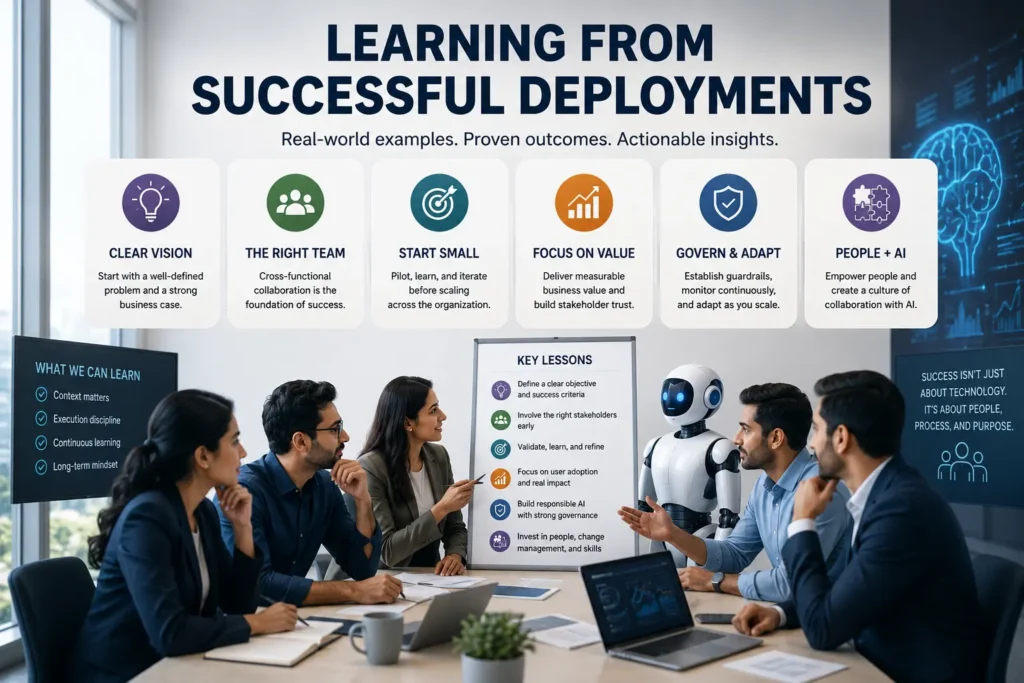
What these companies do differently is that they treat data as the most important part of it all. Without accurate and organized data, there are no artificial intelligence solutions, let alone agentic AI. Besides that, they don’t avoid or try to take shortcuts when it comes to infrastructure and employee training. They also redesign roles deliberately, while keeping a standing feedback loop from the staff that’s actually using the system.
Where to Go From Here
Agentic AI readiness and its deployment are not a single milestone you can hit and then move past. It’s an ongoing discipline that requires keeping your data trustworthy and ensuring that agents are meeting their end goals. Always follow the best practices, which include prioritizing data, defining the agent clearly, drawing on your ecosystem, educating yourself, and getting buy-in for agentic AI.
There are clear signs that agentic AI can offer immense business value, which is why many companies are investing a lot of time and resources to deploy and scale it. However, not all organizations are capable of reaping its benefits yet. Follow the agentic AI readiness model for successful implementation because early movers will set the pace for adoption of this autonomous technology.
Frequently Asked Questions
It depends on where your business currently stands, as there’s no universal timeline for it. If your data is already clean and well-maintained, your infrastructure can handle complex requirements, and your governance policies are well-documented, it could give you an edge. On the other hand, if you lack all of these, it could take you a few to several months before you can even deploy a test agentic AI solution.
It is not necessary to create a new dedicated platform for agentic AI, as it can be built on existing infrastructure, too. What’s more important than the platform itself is the infrastructure to facilitate data movement. The platform should have reliable API access to the systems an agent needs to act on. If your infrastructure can establish orchestration, what platform you use doesn’t matter that much.
That’s the exact question many had when artificial intelligence, especially generative AI, took the world by storm. However, neither generative AI nor agentic AI is intended to eliminate jobs, and they can’t because they will always require some form of human involvement. Currently, AI agents are not advanced enough to make all the decisions on their own. Thus, agentic AI will only change jobs but not eliminate them completely.