Conversational AI: Everything You Need to Know About Machines That Communicate With Humans


Conversational AI is the technology that lets machines understand, process, and respond in human language. Generative AI agents, AI chatbots, and speech recognition software are all common examples of conversational AI. However, it is important to understand how it works, its benefits, challenges, and more to implement and scale these artificial intelligence chat solutions efficiently.
What Is Conversational AI?
Conversational AI refers to technologies that simulate human conversation. Put simply, you can talk to these systems through text or voice, and they will understand the context of what you are saying and respond accordingly. They do this by leveraging massive sets of data, machine learning, and natural language processing.
A couple of decades ago, talking to machines was part of science fiction. Interactive Voice Response (IVR) or even the earlier chatbot models that allowed some form of interaction were pre-programmed. You ask them anything outside these pre-programmed rules, and they will get confused.
Conversational artificial intelligence takes that to a whole new level, especially with the advent of AI agents. This new set of technologies that imitates human discussions has opened a new world of possibilities for both businesses and end users.
How Conversational AI Works
At the very core of conversational AI are two artificial intelligence subsets: machine learning (ML) and natural language processing (NLP).
Machine learning is an AI subfield that works with a set of algorithms that can recognize patterns in data, process them, and learn from them. Thus, these algorithms can improve over time. Therefore, engineers use ML in conversational AI for training and continuous improvement. It also comes in handy when users upload images as inputs for AI chat. ML can interpret images and their meaning through algorithms like Convolutional Neural Networks (CNNs) or Vision Transformers (ViTs).
Natural language processing is the layer that makes it seem like AI is talking to you. It parses raw text or audio and breaks it down into entities through tokenization. It then does part-of-speech tagging and normalization to turn the input into something machines can understand. Earlier versions of NLP helped with computational linguistics and statistical natural language processing. However, the current versions rely heavily on ML to improve conversation quality with humans.
While these are the two technologies primarily responsible for advancements in conversational artificial intelligence, the entire process can be broken down into different steps:
- Input capture: The process starts when a user tries to chat with AI, be it online or through a bot on a platform.
- Input analysis: Analysis depends on the type of input. For text-based inputs, it uses natural language understanding (NLU), a part of NLP. The system will use a combination of NLU and automatic speech recognition (ASR) for audio or voice inputs. While ASR converts spoken language into text, NLU performs three key roles:
- Intent recognition: Understand the user’s intent, such as “check order status” or “cancel subscription”
- Entity extraction: This process is about extracting entities, which are like specific pieces of information, like dates, product names, or order IDs
- Sentiment analysis: Gauging the tone of the input to better interpret context so the system could handle a frustrated user differently than a calmer one
- Dialogue management: Think of dialogue management as the way machines respond to user queries. It tracks every part of the conversation, from what’s already said and what’s stored in the memory to what information it still needs and how the system should respond. Thus, this is also where decision-making happens. The solution, especially a conversational AI agent, will determine if it should ask a clarifying question, fetch information from the backend, or hand off the interaction to a human staff member.
- Response generation: When the dialogue manager has everything it needs in place, natural language generation (NLG), again a part of NLP, turns the information into human-like responses. If the response is supposed to be in speech, a text-to-speech integration turns it into audio.
- Reinforcement learning: All the previous conversational AI interactions are stored on the cloud, and then ML algorithms analyze them to find patterns and learn to further improve conversational NLP responses.
Across these stages, conversational AI can fail or make mistakes at multiple layers. For instance, if it misunderstands or mishears you, it is a perception failure. Similarly, if it forgets what you said a few messages ago, it is a context failure; and if it understands you but gives an irrelevant response, it is a reasoning failure.
Action failure, on the other hand, occurs when the AI bot understands you but cannot take the right action. Trust failure is the most severe, as it occurs when AI guardrails and escalation paths deliberately restrict a tool from taking actions it should perform.
The last two failures are the key reason behind what many people call “dumb AI” or “dumb conversational AI.”
The History of Conversational AI
Conversational artificial intelligence became mainstream only a couple of decades ago. However, its history dates back several decades. It all started when MIT researcher Joseph Weizenbaum built ELIZA in 1966. All it did was simulate interactions by pattern-matching keywords and reflecting user statements back as questions. While it had no clue of any language, it fooled many users and made them believe they were talking to something intelligent.
ELIZA and its descendants worked through this pattern-matching model. But while these systems worked in demos, most failed in practice due to the nuances of human language. Then came the 2001 and 2010 eras, when virtual assistants entered the market. SmarterChild, a chatbot on AOL Instant Messenger and MSN Messenger, was among the first mass-market conversational bots.
Shortly after, voice assistants went mainstream, and it completely revolutionized the machine-human interaction landscape. Apple started this storm through Siri in 2011. Google, Amazon, and Microsoft followed suit with Google Now, Alexa, and Cortana, respectively.
The advent of modern-day conversational AI started in 2017 when multiple Google researchers, including Ashish Vaswani and Jakob Uszkoreit, released the “Attention Is All You Need” paper. It introduced the Transformer architecture, which is at the base of almost every AI-based interactive tool you see today. It is a deep learning model that processes an entire sequence in parallel rather than using a step-by-step recurrence. This improved translation and response accuracy significantly.
BERT, GPT-1, and GPT-2 were introduced as large language models pretrained on massive text corpora based on the Transformer architecture. Then came the public introduction of ChatGPT in November 2022, which propelled the field of conversational AI to a whole new level. And now, AI agents are doing it once again.
AI agent-based conversational AI solutions are the closest we have ever been to Artificial General Intelligence (AGI). However, the challenge will be to move forward and turn these machines that communicate with humans into truly AGI systems.
How RAG GenAI Improves Conversational AI Responses
Since we are discussing how conversational AI works and its advancements over the years, it is important to understand the role Retrieval-Augmented Generation plays in all of this.
One of the biggest limitations of generative language models is that their training data determines what they know. This knowledge usually has a cut-off date. If you ask a basic LLM-powered chatbot a personalized query, it will either say it does not know or start hallucinating. Hallucination in artificial intelligence is a phenomenon where the bot will confidently make something up to give a response.
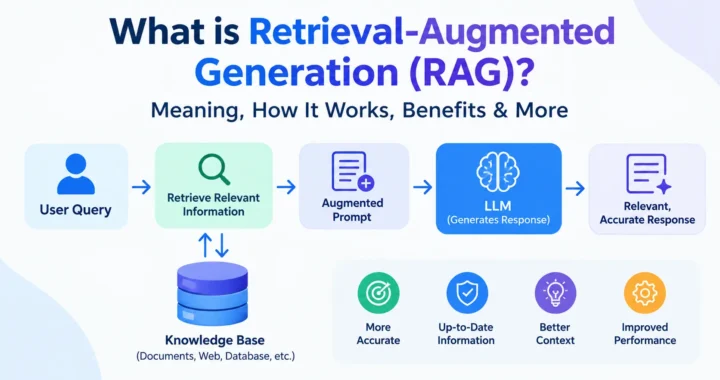
Retrieval-Augmented Generation (RAG) solves this issue by connecting the LLM model to an up-to-date knowledge base. Here’s what RAG does:
- Instead of relying only on training data, it converts the user’s query into a numerical representation of its meaning, called the vector embedding
- It will look for a knowledge base through vector similarity search to get the most recent and relevant information
- Feed the retrieved information into the LLM along with the user query
- The LLM model generates a response by combining its training data and the retrieved information
What this means for conversational AI is that a chat bot can answer queries about news that was revealed or published only a few minutes ago. This reduces the extent of hallucination, which was a significant factor behind interactive AI project failures.
Types of Conversational AI
There are multiple ways to differentiate one conversational artificial intelligence type from the other. How it communicates, what it can do, and how much autonomy it has can all be the basis for this categorization. The table below represents some widely known types of conversational AI.
| Type of Conversational AI | What It Does | Real World Example |
| Rule-based chatbots | Relies on predefined rules and keywords | Basic website FAQ bots or scripted customer service bots |
| AI chatbots | Understand natural human language and respond either with generated responses or preset answers | ChatGPT, Google Gemini, Microsoft Copilot, or other generative AI models |
| Voice assistants | Understand and respond in spoken language | Apple Siri and Amazon Alexa |
| Virtual customer service agents | Handle customer complaints, questions, or account requests | Banking chatbots, airline support bots, or telecom customer service bots |
| Conversational commerce assistants | Help users navigate eCommerce sites through conversational AI to look for products, compare options, and make purchases | Sephora’s Virtual Artist on Messenger and H&M’s style bot |
| Generative AI assistants | Generate content in the form of text, images, videos, audio, etc. | ChatGPT and Claude |
| Domain-specific conversational artificial intelligence | Focuses on a particular industry | GatorTronGPT for healthcare, Blue J for legal, and Eddy Travels for travel |
| Multimodal conversational AI | Multimodal means understanding and responding in different means of communication, including text, voice, video, images, and other forms of input | Google Gemini Live |
| Agentic conversational AI | A conversational AI system that uses AI agents to understand a goal, plan multiple steps, use tools, and perform actions with limited human intervention | Intercom’s Fin AI Agent |
Benefits of Conversational AI
According to Grand View Research, the conversational AI market size is estimated to reach $78.9 billion by 2033. During the forecast period from 2026 to 2033, the market could grow at a CAGR of 23.8%.
A key reason behind this growth is the wide range of benefits these solutions offer across both personal and professional life, including but not limited to:
- Round-the-clock availability: Unlike human teams, artificial intelligence chat services can work 24/7 without any breaks. Even if the customer has some queries or wants to get some changes done to their account at 3 or 4 am on a Friday night, they won’t have to wait till Monday to get a response. This matters a lot in industries where delayed responses can cost businesses, such as an abandoned cart or a missed fraud alert.
- Cost reduction: One of the standard benefits of any form of automation is cost reduction, and conversational artificial intelligence is no exception. As these systems interact with consumers, human agents are free to focus on complex, high-value work. For instance, a telecom service provider can deploy a talking AI solution for the bulk of its tickets, which are related to password resets, plan upgrades, and billing questions. This will free human agents to work only on complex disputes.
- Scalability: Suppose an eCommerce company offers discounts on selected products during holiday sales. This will boost queries and demand instantly, but hiring a new customer service agent would require a lot of time. On the other hand, businesses can scale conversational AI systems instantly. They can handle one or thousands of interactions simultaneously.
- Personalization at scale: Modern solutions not only understand and respond to queries; they also remember. With an application programming interface (API), they can reference purchase history, prior interactions, account status, account details, and much more to make every conversation feel more personal. And this is not limited to using first and last names to interact or recommending products and services. These systems can even help with inquiries about previous orders or collect live feedback from customers, so they feel heard.
- Actionable data insights: Every conversation generates data, and every piece of data, when analyzed, provides actionable insights. Conversational AI tools can aggregate all the data from the interactions it has with users and let machine learning algorithms detect patterns in it. What makes this more useful is that the data collected here comes straight from consumers and can be used as feedback to find early issues in products and services.
- Better accessibility: Users can chat with AI online via a website or dedicated software; they can use it for text and voice-based interactions. All of this makes use of conversational AI accessible to even people with visual impairments, limited literacy, or language barriers.
What Are the Different Use Cases for Conversational AI?
Broadly speaking, people can use conversational artificial intelligence for various purposes. For instance, informational use cases refer to leveraging these tools to answer customer inquiries or guide them to take some actions. Data capture use cases involve collecting user feedback or details.
Similarly, there’s transactional conversational AI, where the solutions help users with tasks that involve some form of transactions. This can include placing orders on eCommerce platforms or buying movie tickets. Then there are proactive use cases where these tools proactively interact with consumers, be it for reminding them about an upcoming appointment, any unfinished tasks, or something else.
The end users are also increasingly relying on these systems for a wide range of requirements. For example, some people use them for AI girlfriend chat, as if they are in a relationship. Many others have felt really comfortable opening up to them about their struggles, which has helped conversational AI play a role in mental health support. However, it is a risky practice since machines can never truly understand human emotions and contextual nuances that are essential for providing the right support.

Regardless of how you decide to use it, here are some conversational AI examples:
Online Customer Support
While conversational AI tools can offer frontline support, too, online contact centers see the biggest benefit. It can be challenging for a customer to interact with a machine in person. However, they prefer talking to bots over calls when contacting a customer support department online.
Implementing AI bots here ensures:
- Consistent tone
- Improve agent efficiency
- Offer multilingual support, especially for multinational brands
- Omnichannel support
Conversational AI can do wonders for customer engagement by integrating with customer relationship management (CRM) platforms or other business tools to increase personalization. Moreover, since these solutions are scalable and can handle hundreds of interactions simultaneously, they significantly reduce standard call center wait times.
As they learn over time, they become more accurate in providing information, enhance customer satisfaction, and increase problem-resolution efficiency. And once a customer is satisfied with the resolution, their use and reliance on these systems increase. As an AI chatbot starts offering round-the-clock services and handling the bulk of queries, human agents are free to pay more attention to truly complex issues.
HR & Internal Processes
Conversational AI in HR has use cases such as answering candidate queries, personalized onboarding, summarizing and reading out internal policies, and much more.
Consider the example of employee training, which costs businesses thousands of dollars annually, yet they still invest in it because of its importance. A Harvard Business School article notes that training employees pays off for companies twice as much. That’s because it not only helps staff get better at what they do but also frees managers to focus on more strategic tasks.
“From a leadership perspective, if you double everyone’s skill, do you need as many managers overseeing them?”
Per Harvard Business School.
The end-to-end hiring process can benefit from the use of conversational AI for HR. It can engage with candidates before recruiters step in to improve talent acquisition, and it can also facilitate unbiased exit interviews by mitigating social pressure to provide honest feedback. Everything in between, from scheduling and initial interviews to onboarding and self-service, finds a use case for this technology.
Healthcare
We all know how difficult it can be for patients to understand the jargon healthcare professionals use. And more often than not, even doctors can find it challenging to explain everything in layman’s terms. This communication gap leads to a lack of trust and misunderstandings. The use of conversational AI in healthcare mitigates this problem. This leads to better patient engagement and enhanced care satisfaction.
Healthcare conversational AI can be composed of artificial intelligence chatbots, voice assistants, generative AI tools, and other common types. Patients can even benefit from proactive use cases here, as they can help with medication adherence. When presented with a medication timeline, these solutions can trigger an interaction with patients at the time to take their medications. With automated workflows, they can even notify healthcare professionals whenever a patient misses a dose for early intervention.
Banking
Advancing conversational AI in banking is of utmost importance to cope with the growing divide between digital adoption and trust. More and more are moving their services online, but many customers find friction when using them. As a result, customers have to interact with online chatbots to get answers to their queries. If this experience is not seamless, it results in hesitancy about using online services. Therefore, the level of conversational AI banking needs to go up to avoid such scenarios.
Some common conversational banking benefits include:
- Customer support
- Self-service transactions
- Customer onboarding
- Agent assist
- Payment reminders and processing
- Data capture and analytics
Retail
Use of AI in retail has grown exponentially since online shopping became mainstream. Now, conversational AI eCommerce can make that entire online shopping experience seamless. Traditionally, retailers have used AI to the extent of product recommendations and personalization. Advanced use cases include demand forecasting and dynamic pricing.
Conversational AI in retail, however, can assist customers throughout the online shopping experience. From comparing products and placing orders to handling shipping and accessing customer support, customers can ask conversational AI assistants to do all those things right in the middle of their shopping journey.
Autonomous Vehicles
Imagine you are riding in a self-driving car and decide to listen to some music. If you are sitting in the driver’s seat or an adjacent seat, you can do it easily from the dashboard. Many cars even provide a device in the back seat to control those things. But what if you don’t have to do any of that? With a conversational AI device installed in the car, you can simply give it voice commands to listen to your favorite music while enjoying your ride.
Similarly, you can discuss the optimal route to reach your destination, get notifications about your car’s health or maintenance schedule, and ask any questions about how it works. With all these and many more capabilities, conversational AI can certainly be part of self-driving vehicles with Level 5 autonomy.
Social Media
Businesses, celebrities, influencers, and end users can all leverage this technology for responding to comments, responding to direct messages, etc. Consider the example of a Facebook AI chatbot or conversational AI WhatsApp. These are built-in assistants natively powered by Meta AI. You can ask them questions, create images, or summarize chats. It can also bridge language gaps between businesses and customers since social media allows people to connect even with those located on the other side of the globe.
Conversational AI vs. Generative AI: Key Differences
Understanding the distinction between conversational artificial intelligence and generative AI matters.
Many get confused between the two because even generative AI takes a prompt and gives a response by generating new content, be it text, images, speech, music, or video. However, the key difference between the two is what they focus on. Generative AI focuses on outputs based on user prompts. Conversational AI, on the other hand, focuses more on back-and-forth interactions through natural language.
Not every generative AI solution is conversational, and not every conversational AI model generates new content. However, the overlap between the two is growing today. More and more modern-day generative AI solutions can facilitate human conversations today. Consider ChatGPT AI chat or Google chatbot Gemini. Both of them can converse as well as generate content.
The table below lists the core differences between the two terms:
| Feature | Conversational AI | Generative AI |
| Goal | Context-aware dialogue while retaining memory | Create new content based on prompts |
| Output | Answer questions and follow commands | Text, images, code, synthetic data |
| Training data | Conversations, domain-specific knowledge bases | Massive general datasets about the topics it focuses on |
| Core technologies used | NLP, ML, and dialogue management | Large language models(LLMs) |
| Reliability | High reliability but within a limited scope | High chances of hallucinations |
Overcoming Challenges of Conversational AI Adoption
Conversational AI has a wide range of benefits, but it is still not widely adopted because of the following reasons:
- Data security: Some conversations may contain sensitive information. For instance, transactional uses, AI adult chat, or seeking medical help can all involve private information that clients would not want to fall into the wrong hands due to cybersecurity failures.
- User trust: While bots are not intelligent enough yet to fool people into thinking that they are interacting with humans, transparency still matters. If consumers feel that they are deceived in any form, they could lose all trust in artificial intelligence conversations. Similarly, when things escalate, such as a billing dispute gone wrong, users prefer to interact with humans. If the solution cannot understand that and hand over the issue to a human agent, it will impact trust levels.
- Integration complexity: Connecting conversational AI systems with legacy systems can be challenging. In some instances, businesses can lose valuable data because of leakage. However, IT service providers or engineers usually create a local backup of everything before starting with integration or transitioning to a new system.
- Maintaining brand voice and tone: While modern-day conversational AI solutions can learn over time, maintaining a consistent brand voice can pose an initial challenge. If companies don’t want this to happen, they need to train their tools on massive datasets, which can be resource-intensive and even negatively impact the environment.
- Change management and resistance: Some employees may see these systems as a threat to their job. This can create friction during rollout, as many might be resistant to using the new solution. In this case, businesses and management will have to be transparent and let them know that conversational AI tools are meant to support them, not replace them.
- Failure modes and anti-patterns: Conversational AI can face many failure modes. Hallucination, as discussed above, is when artificial intelligence starts making things up. Then there’s sycophancy, which refers to AI telling you what you want to hear rather than what’s accurate. These models will agree with you to your detriment. Context collapse in longer conversations and agentic conversational AI taking unwanted actions are also some failure modes that need to be addressed before mainstream adoption.
The Future of Conversational AI
The near-term future of conversational AI is reliant on integration with AI agents and agentic AI. Rather than one model doing everything, this blend will introduce coordination among a wide range of agents specialized in different tasks. This will address limitations of current conversational AI models that largely focus on a single domain or use case.
Conversational AI is also increasingly moving from cloud to local, on-device models. The move aims to improve privacy and reduce latency. The reduced latency could further improve edge-case handling, as it would be better adapted to making decisions to escalate cases as and when necessary.
Persistent memory will also become a norm in the near future. Currently, some solutions are unable to retain messages from the ongoing chat. However, engineers and businesses are adamant about making systems that can remember cross-session chats for better user satisfaction.
Emotional intelligence is also something we are focusing on. The new generation of conversational AI technology will detect changes in voice and tone to understand users’ current emotional state and respond accordingly. With advancements in RAG, fact-checking layers, and model reasoning capabilities, the aim is also to reduce hallucinations and other failure rates.
All in all, what we are seeing right now in the conversational AI space is just the tip of the iceberg. As technology improves, there’s a lot more these solutions can provide. However, it all depends on how ready businesses are to implement and scale them. Therefore, companies should assess their conversational and agentic AI readiness to seize the opportunity and benefit from new conversational AI models.
Conclusion
Conversational AI has moved from a chatbot that couldn’t understand a misspelled question to core infrastructure for human-machine interaction. The evolution of technology, especially the shift toward generative, LLM-powered systems augmented with RAG and agentic AI, has expanded what’s possible. However, it’s not all that simple. Customer trust is conditional and can be easily lost, while successful adoption and implementation require appropriate infrastructure and ongoing investment. Businesses need proper oversight, realistic budgeting, and a proven framework to deploy conversational artificial intelligence successfully.
Frequently Asked Questions
While chatbots can be conversational, they are not the same as conversational AI technology. In fact, a chatbot is just one form of this technology. Conversational artificial intelligence is the broader set of technologies like NLP, machine learning, and dialogue management that powers voice assistants, virtual agents, and more alongside chatbots.
Common conversational AI examples include voice assistants like Siri and Alexa, customer support chatbots, ChatGPT and Claude, etc. Any form of artificial intelligence-powered platform or device that can have a back-and-forth interaction in human language is an example of conversational AI.
Yes, ChatGPT is a conversational AI. While it falls broadly under generative AI tools, it is wrapped in a conversational interface. This interface can support multi-turn dialogue and generate human-like responses, making it a form of conversational artificial intelligence. It’s a general-purpose system rather than a business-specific one.
There’s no single best option, as each one serves its own purpose. For instance, ChatGPT and Claude are general-purpose tools that are strong for open-ended conversation. Similarly, there are specialized tools such as Rasa for regulated industries, Kore.ai for large enterprise workflows, and Zipchat for e-commerce. Instead of looking for the best conversational AI solution, you should look for something that fits your specific needs.
This depends on the service provider’s data handling policies, security certifications, and compliance posture. It’s worth reviewing a vendor’s data privacy documentation directly, especially for sensitive industries like healthcare or finance.