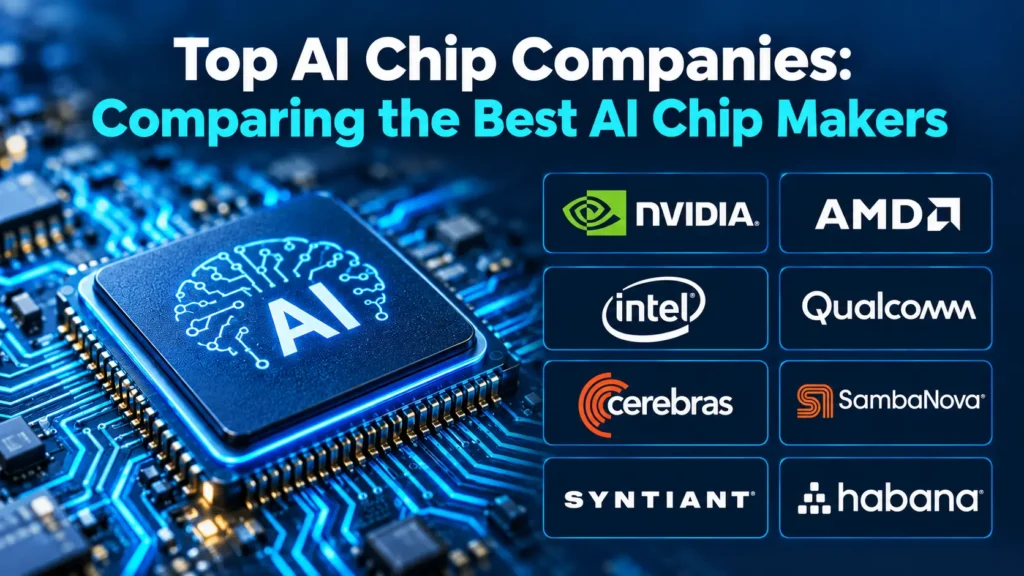
Top AI Chip Companies: Comparing the Best AI Chip Makers

Computer processing units (CPUs) excel at handling sequential tasks. But the shift from general-purpose computing to massive parallel processing, and the demand for deep learning with the advent of artificial intelligence (AI), called for chips designed specifically for AI tasks.
Since then, AI advances have reshaped the semiconductor industry. According to Precedence Research, the global AI chip market is valued at $121.73 billion in 2026. However, it is estimated to grow at a CAGR of 27.88% through 2035 to reach a whopping $1,104.68 billion.
As demand rises, more AI chipmakers are entering the race to lead this booming sector. Here are the top AI chip companies that have already made a name for themselves.
Why AI Companies Want to Build Their Own Chips
Many multi-million-dollar AI companies are now building their own chips. For instance, OpenAI (the company behind ChatGPT) announced its custom AI chip, Jalapeño. Similarly, Google has its Tensor Processing Units (TPUs), while Meta has built Meta Training and Inference Accelerator (MTIA) chips.
The reasons why all these companies and many more are trying to build their own chips are:
- Reducing dependency on NVIDIA: NVIDIA is currently the world’s largest AI chip supplier, allowing companies to shift pricing strategy and control demand and supply. Relying on a single supplier creates risks businesses want to mitigate.
- Cost control: While developing your own AI chip comes with a significant price tag, costs can go down in the long run.
- Customization: Top AI companies are building their own chips to make them more efficient for their workloads.
- Full-stack optimization: An artificial intelligence company that handles the entire stack, from chip and software to the AI model, gains more flexibility to optimize end-to-end. This optimization can further reduce AI’s carbon footprint by streamlining training and inference.
While building your own chip offers major benefits, it also comes with a few trade-offs. For instance, it comes with massive upfront costs. Chip design and fabrication require billions of dollars in R&D before a single chip ships. Long development timelines and the risk of falling behind also add pressure.
Building custom AI chips is a bet that’s only rational at a certain scale. That’s why only the top companies with enough resources are entering the race to build their own custom AI chips.
But the list is still very long.
Top AI Chip Companies Explored
If you are even a tiny bit familiar with AI chips, you’ve probably heard the name NVIDIA. But while it has been a constant in this space, many other top AI chip companies have made their mark.
NVIDIA AI Chip
NVIDIA sells the dominant general-purpose AI GPU platform. Its advantage goes beyond the chip. The GPUs are co-designed with CPUs, NVLink switches, networking, and a large software stack, including CUDA, which keeps developers on its hardware.
Current products:
- Blackwell Ultra: comes as the GB300, which pairs two GPUs with an Nvidia Arm CPU, and the GPU-only B300. It’s also offered as an eight-GPU server blade or a 72-chip rack.
- Vera Rubin: the successor, and no longer just a roadmap item. Nvidia told investors production shipments began in August 2026. The flagship NVL72 rack pairs 72 Rubin GPUs with 36 Vera CPUs, and it’s the first generation where the GPU, CPU, memory, rack, and network were all redesigned together. Reported per-GPU figures are 288 GB of HBM4, 22 TB/s of memory bandwidth, and 50 petaFLOPS of FP4 inference. Treat these as vendor-reported numbers.
- Roadmap: Rubin Ultra is planned for 2027 and Feynman for 2028.
In March 2026, Nvidia debuted an inference offering that pairs its GPUs with technology licensed from Groq.
Best for: Almost any serious AI workload, especially large-scale training, where the software ecosystem matters.
Trade-offs: Premium pricing, very high rack-level power draw, and customers’ strategic discomfort at depending on one supplier (the reason many of the others in this section exist).
AMD Instinct AI Chip
AMD competes mainly on memory capacity, price-performance, and an open software approach (ROCm) as an alternative to CUDA.
Current products:
- MI350 series (MI355X): Built on the CDNA 4 architecture, each GPU carries 288 GB of HBM3E memory with 8 TB/s of bandwidth, and AMD supports it with its ROCm 7 software stack. It’s the chip already running in cloud data centers.
- MI455X and Helios: At its Advancing AI event on July 23, 2026, AMD launched Helios, a liquid-cooled rack combining 72 Instinct MI455X GPUs, 18 sixth-generation EPYC Venice CPUs, and Pensando networking, with up to 31 TB of HBM4. The MI455X uses TSMC’s 2nm process and CDNA 5, packs 320 billion transistors, and drops FP64 to focus on AI formats like MXFP4 and MXFP8. It’s AMD’s first system aimed directly at Nvidia’s Vera Rubin NVL72, and executives from OpenAI and Anthropic appeared on stage.
- Cadence: AMD said on its August 2026 earnings call that it plans a new rack-scale AI platform every year, and its roadmaps now name MI500 and MI600 generations.
Best for: Buyers who want a credible second source to Nvidia, especially for memory-hungry inference.
Trade-offs: A software ecosystem still less mature than CUDA, and the Helios timeline means customer availability lags the launch event. Check the shipping status before treating it as deployable.
Google AI Chip
Why it’s different: Google designs TPUs for its own workloads (Search, Gemini, YouTube) and rents them through Google Cloud.
Current products:
- Ironwood (7th generation): Each chip delivers 4,614 FP8 TFLOPs with 192 GiB of HBM at 7,380 GB/s, and a pod scales to 9,216 chips. Google called it its most powerful TPU yet, with 10 times the peak performance of TPU v5p. Access is through Google Kubernetes Engine by contacting the account team.
- TPU 8t and 8i (8th generation): Unveiled April 22, 2026, this is the first time in the line’s decade-long history that Google split it in two. The training-focused 8t scales to 9,600 chips and 121 ExaFlops per superpod, with Google claiming 2.8 times better price-performance. The inference-focused 8i has 384 MB of on-chip SRAM and 288 GB of HBM, with claimed gains of up to 80% better performance per dollar and double the performance per watt. General availability is expected in the second half of 2026.
Google isn’t going Nvidia-free. It said it will be among the first to offer Nvidia Vera Rubin NVL72 systems. Outside customers matter too: Anthropic expanded its TPU partnership to multiple gigawatts of next-generation capacity.
Best for: Large training and inference runs on Google Cloud, especially with JAX or TensorFlow.
Trade-offs: Mostly tied to Google’s cloud, and less flexible than GPUs for teams with CUDA-based code.
Intel AI Chip
Intel’s AI accelerator story is a restart. Gaudi 3 launched in April 2024, but uptake was slower than expected, and Intel missed its $500 million Gaudi revenue target that year. Intel also canceled Falcon Shores in January 2025.
Where it’s headed:
- Gaudi 3: Still sold and supported, with a rack-scale reference design for up to 64 accelerators and 8.2 TB of high-bandwidth memory per rack.
- Crescent Island: An inference-focused data-center GPU on the Xe3P architecture with 160 GB of LPDDR5X memory. It’s built for energy efficiency and low cost, with customer sampling planned for the second half of 2026.
- Jaguar Shores: The longer-term GPU architecture.
Intel holds a leading position as the host CPU in AI servers, and its PC chips include NPUs, roughly at the 50 TOPS level in the current generation. There’s also a financial tie to a rival: Nvidia invested $5 billion in Intel for roughly a 4% stake.
Best for: Cost-sensitive inference deployments and customers who want an Intel-based host-plus-accelerator stack.
Trade-offs: A history of AI-accelerator misses, a roadmap that keeps changing, and no independent benchmarks yet for Crescent Island.
Amazon (AWS) AI Chip
Why it’s different: AWS builds chips to lower its own cloud costs and offer customers a cheaper alternative to Nvidia. Inferentia was the earlier inference-focused line, while Trainium now covers both jobs: AWS says Trainium3 improves both training and inference over Trainium2.
Current products:
- Trainium3: Amazon’s first 3nm AI chip. A Trn3 UltraServer holds up to 144 chips, delivering 362 FP8 petaflops. AWS claims 4.4 times more compute, four times the energy efficiency, and nearly four times the memory bandwidth of the previous generation. It’s generally available, with customers including Anthropic, Karakuri, and Ricoh.
- Scale in practice: AWS has deployed over one million Trainium chips, and the majority of Amazon Bedrock inference now runs on them.
- Trainium4: AWS says it will deliver at least six times the FP4 performance, three times the FP8 performance, and four times the memory bandwidth, and will support Nvidia’s NVLink Fusion interconnect. AWS hasn’t confirmed a firm date, though one analysis points to late 2026 or early 2027.
AWS is hedging in several directions. Trainium4’s NVLink Fusion support means Trainium, Graviton CPUs, and networking can work across Nvidia’s MGX racks. AWS also struck a major deal with Cerebras.
Best for: Teams already on AWS wanting lower inference and training costs, particularly through Bedrock.
Trade-offs: Available only on AWS, and code often needs adapting to Amazon’s Neuron software.
Apple AI Chip
Apple doesn’t sell AI chips to anyone. It builds them into iPhones, iPads, and Macs, and what sets them apart is how tightly they integrate. The CPU, GPU, and Neural Engine all draw from one large pool of unified memory, reducing latency.
Recent products:
- Neural Engine history: Apple has had one since the A11 in the iPhone X. The first managed 600 billion operations per second, while recent versions exceed 35 trillion. The iPhone version had 16 cores for three generations.
- M5 (October 2025): Added a Neural Accelerator inside every GPU core, delivering over four times the peak GPU compute for AI compared with the M4. Unified memory bandwidth rose to 153 GB/s.
- M6 (August 2026): Apple’s first 2nm chip, with a Dual 16-core Neural Engine that system frameworks can use simultaneously for up to twice the peak compute.
- A20 Pro (September 2026): Built on 2nm, it brings the dual Neural Engine design to the iPhone 18 Pro. Apple says it delivers double the AI processing power of the A19 Pro and 50% more memory bandwidth.
The Metal 4 Tensor APIs give developers direct control of the GPU’s Neural Accelerators.
Best for: Private, low-latency on-device AI (Apple Intelligence, photography, local models on Macs).
Trade-offs: Apple’s ecosystem only, and nowhere near data-center scale. Performance figures are Apple’s own.
Qualcomm AI Chip
Two businesses in one:
- On-device NPUs (the established business): The Snapdragon X2 Elite and X2 Elite Extreme raise the Hexagon NPU from 45 TOPS to 80 TOPS, and the Extreme variant offers up to 18 cores. Devices were expected in the first half of 2026. Qualcomm claims this beats the Apple M4 by 95% and Intel’s Lunar Lake by 122% on NPU TOPS. Those are Qualcomm’s numbers, and TOPS alone doesn’t decide real-world performance. The same generation of Hexagon NPU architecture is reportedly shared with its flagship phone chip.
- Data-center inference (the new bet): The AI200 and AI250 are built on Hexagon NPU technology and optimized for inference. The AI200 supports 768 GB of LPDDR memory per card. It’s due in 2026, with the AI250 following in 2027, and Saudi AI company Humain plans to deploy 200 MW of the racks starting in 2026. The AI250 uses a near-memory computing design claimed to deliver more than ten times the effective memory bandwidth. Qualcomm has promised an annual cadence, with a next-generation product targeted for 2028.
Best for: Always-available Windows laptops and phones with strong battery life, and (still unproven) cost-efficient inference serving.
Trade-offs: The data-center push is new and mostly untested. Qualcomm previously tried server processors with its Centriq chips before refocusing on mobile and edge. Independent benchmarks will matter.
Cerebras AI Chip
Cerebras builds AI systems around one unusual idea: instead of cutting a silicon wafer into hundreds of small chips, use the whole wafer as a single processor. The company listed on Nasdaq under the ticker CBRS in May 2026, raising roughly $6.38 billion at $185 per share.
Wafer-Scale Engine 3 (WSE-3) is its flagship product. The WSE-3 packs about 4 trillion transistors organized into 900,000 cores, and Cerebras says it offers 27 petabytes per second of memory bandwidth, over 200 times what Nvidia’s NVLink interconnect provides.
The company also claims the chip is 58 times larger than a leading GPU and delivers inference up to 15 times faster than GPU-based solutions on open-source models. These are the company’s own benchmark claims, so treat them as marketing until independently verified.
Keeping everything on one giant piece of silicon removes the slow hops between separate chips.
OpenAI agreed to buy 750 megawatts’ worth of inference infrastructure, and Cerebras has a “disaggregated” inference arrangement involving Amazon’s Trainium chips, with the WSE-3 handling the decode phase. The company raised $1 billion at roughly a $23 billion valuation in February 2026.
Best for: Very fast inference and training of large models where latency matters.
Trade-offs: Unusual system design (cooling, power, packaging), and a software ecosystem far smaller than Nvidia’s.
Groq AI Chip
Groq built the LPU (Language Processing Unit), an inference-only chip designed to run language models with very low latency. The LPU was originally branded the Tensor Streaming Processor.
Most AI chips lean on external HBM memory. Instead, the LPU stores model weights directly in hundreds of megabytes of on-chip SRAM, cutting latency and keeping the compute units fed. The trade-off is that SRAM is expensive and capacity-limited, so large models need many chips working together.
On December 24, 2025, Nvidia announced a non-exclusive licensing deal worth roughly $20 billion for Groq’s inference architecture, and founder Jonathan Ross and president Sunny Madra moved to Nvidia.
Groq says it continues to operate independently, running GroqCloud, though most of the technical team that built the LPU went to Nvidia. Whether Groq stays a competitive chip designer or becomes mainly a cloud service is an open question.
Best for: Real-time, low-latency language model serving.
Trade-offs: Inference only (no training), limited per-chip memory, and an uncertain long-term roadmap after the Nvidia deal.
SambaNova: The Enterprise Dataflow Approach
Founded in 2017 by Stanford researchers, SambaNova makes the SN40L and its Reconfigurable Dataflow Unit (RDU) architecture. The SN40L launched in September 2023 and can run models of up to five trillion parameters.
Where Groq bets on SRAM alone, SambaNova uses a tiered memory design. The SN40L keeps data across three types of memory (fast SRAM, HBM, and DRAM), which reduces data movement and speeds up model loading. It ships in a SambaRack appliance holding 16 chips.
SambaNova pivoted in 2025 from training workloads toward being an AI cloud services provider. Intel pursued a roughly $1.6 billion acquisition, but talks collapsed in January 2026. In February 2026, Intel joined a $350 million funding round and signed a multiyear collaboration.
Best for: Enterprises and sovereign-AI projects wanting managed inference on large models.
Trade-offs: Smaller developer ecosystem, and the company has had funding and valuation pressure.
IBM AI Chip
IBM isn’t chasing Nvidia on raw scale. It targets banks, insurers, and other regulated industries that want AI running next to their most sensitive transaction data.
Products: Two chips work together.
Telum II is the mainframe’s main processor. It has eight cores at 5.5 GHz, 360 MB of on-chip cache, and a built-in data processing unit, manufactured by Samsung on a 5nm process.
Spyre Accelerator is an add-on AI card. Each PCIe card has 32 AI-optimized cores, 25.6 billion transistors, and 128 GB of LPDDR5 memory, delivering 300 TOPS; a mainframe can hold up to 48 cards.
Spyre became generally available on October 28, 2025, for IBM z17 and LinuxONE 5 systems, with Power11 servers following in December.
The design aims to let clients keep mission-critical data on-premises while running low-latency generative and agentic AI. Security, uptime, and data locality matter more here than benchmark wins.
Best for: Fraud detection, transaction scoring, and AI inside existing IBM Z environments.
Trade-offs: Only for IBM platforms, so there’s no general-market reach.
Syntiant AI Chip
Syntiant (founded in 2017, based in Irvine, California) builds Neural Decision Processors (NDPs), tiny chips for always-on AI in battery-powered devices.
Flagship: NDP250. Launched in April 2024 on the Syntiant Core 3 architecture, it delivers five times the tensor throughput of the previous generation, at 30 GOPS. It targets person detection, speech recognition, text-to-speech, and motion tracking, and pairs an Arm Cortex-M0 processor with a HiFi 3 DSP. The company’s pitch is that tasks that once needed watts of power can now run on microwatts.
It’s built to stay on constantly (wake words, motion detection) while sipping power, so it can’t compete on raw speed.
Best for: Earbuds, smart home devices, wearables, video doorbells, battery-powered cameras.
Trade-offs: Handles only small models. It supports roughly six million parameters in 8-bit mode, so it’s useless for large language models.
Habana Labs AI Chip
Habana Labs was an Israeli AI chip startup that Intel bought for about $2 billion. Its flagship is the Gaudi accelerator line. Intel launched Gaudi 3 in 2024, claiming 1.8 times better price-performance than Nvidia’s H100. By then, Habana had been dissolved as an independent company and merged into Intel.
Intel still sells Gaudi 3 and supports Gaudi 2, but its AI roadmap has shifted. The Falcon Shores project stays internal; Intel has added an inference-focused chip called Crescent Island (customer sampling planned for the second half of 2026), and Jaguar Shores is the longer-term GPU architecture. The direction is toward programmable Intel GPUs rather than Gaudi-specific accelerators.
Best for: Cost-conscious teams that can work with Intel’s software stack.
Trade-offs: Roadmap uncertainty and a less mature software ecosystem than Nvidia’s.
Arm AI Chip
Arm licenses a processor architecture that others build on. Apple, Qualcomm, and many phone and edge AI chips use it, and its Ethos NPU designs are licensed for small AI accelerators in embedded devices.
In 2026, Arm stopped being licensing-only. It revealed the Arm AGI CPU, a production-ready chip for AI data center inference, built from its Neoverse cores, with Meta as co-developer and first customer, and OpenAI, Cerebras, and Cloudflare as launch partners. It has up to 136 cores running at up to 3.7 GHz on TSMC’s 3nm process, with broader availability expected in the second half of 2026.
It’s a CPU, not an accelerator. It manages data movement and scheduling around GPUs and other accelerators. It also puts Arm in direct competition with some of its own customers.
Best for: Efficient hosts for AI racks and the base architecture inside most phones and edge devices.
Trade-offs: Arm now has to balance selling chips against keeping its licensees happy.
Side-by-Side Comparison of Top AI Chip Companies
| Player | Current flagship products | Chip type | Main job | Standout | Main limitation |
| Nvidia | Blackwell Ultra; Vera Rubin shipping | Merchant GPU | Training + inference | CUDA ecosystem, full rack systems | Price, power, supply |
| AMD Instinct | MI355X; Helios/MI455X launched | Merchant GPU | Training + inference | Memory capacity, open software | Software maturity |
| Ironwood; TPU 8t/8i (H2 2026) | Custom ASIC | Training (8t), inference (8I) | Training/inference split, huge pods | Cloud-locked | |
| Intel | Gaudi 3; Crescent Island sampling | GPU/accelerator | Inference focus | Host-CPU position | Roadmap uncertainty |
| Amazon | Trainium3; Trainium4 coming | Custom ASIC | Training + inference | Cost, Bedrock scale | AWS lock-in |
| Apple | M6, A20 Pro (dual Neural Engine) | On-device NPU + GPU | Local AI | Unified memory | Closed ecosystem |
| Qualcomm | Snapdragon X2 (80 TOPS); AI200 | NPU / inference accelerator | On-device + inference racks | Power efficiency | Data center unproven |
| Cerebras | WSE-3 | Wafer-scale processor | Fast inference + training | The largest single chip made | Unusual power, cooling, and system design |
| Groq | LPU | Inference ASIC | Low-latency LLM serving | Very low latency for real-time language model responses | Inference only and limited memory per chip |
| SambaNova | SN40L (RDU) | Reconfigurable dataflow | Enterprise inference | Tiered memory lets it run very large models | Smaller developer ecosystem |
| IBM | Telum II + Spyre (300 TOPS) | Mainframe AI + accelerator | Secure enterprise inference | Runs AI right next to sensitive transaction data, on-premises | Works only within IBM platforms |
| Syntiant | NDP250 (30 GOPS) | Ultra-low-power NPU | Always-on edge AI | Runs AI on microwatts | Handles only small models |
| Habana | Gaudi 3 | Training/inference accelerator | Value alternative to GPUs | Price-performance pitch | Intel’s roadmap is shifting toward Xe GPUs |
| Arm | AGI CPU / Ethos NPU | CPU product + licensed IP | AI-rack host + edge IP | Architecture sits inside most phones and edge devices | It’s a CPU, not an accelerator |
How to Actually Compare AI Chips
Chip manufacturers love to advertise huge numbers. But raw computational throughput (FLOPS- floating-point operations per second) only tells part of the story. A chip can have enormous theoretical FLOPS and still perform poorly in the real world if memory bandwidth can’t keep the cores fed, or if the software doesn’t take full advantage of the hardware.
Because spec-sheet numbers can be misleading, the industry relies on standardized benchmarks, most notably MLPerf. It is an independent benchmark suite that tests chips on actual AI workloads, not synthetic best-case numbers. This gives a much more honest, apples-to-apples comparison than manufacturer marketing.
If you’re ever in a position to choose hardware for a project, ask:
- What’s my actual workload? (Training vs. inference; large models vs. small)
- What’s my budget, upfront and ongoing? (Buy vs. rent; power costs)
- What does the real-world benchmark data show (MLPerf), not just the spec sheet?
- What software ecosystem do I need? (Some chips have far better tooling/support than others)
- Do I need flexibility, or is my task fixed and high-volume long-term? (Flexibility favors GPUs/FPGAs; fixed high-volume favors ASICs)
The Global Supply Chain Behind Every Chip
The global supply chain of AI chips primarily consists of four processes, which include:
- Design: Companies like Nvidia, AMD, and Google design the chip’s architecture, but they don’t manufacture it themselves.
- Fabrication: The actual physical manufacturing happens at specialized factories called “fabs,” dominated overwhelmingly by TSMC (Taiwan) and, to a lesser extent, Samsung (South Korea) and Intel.
- Lithography equipment: Fabs can’t build cutting-edge chips without extremely precise machines that etch circuit patterns onto silicon. A single company, ASML (Netherlands), makes the most advanced of these machines (EUV lithography systems).
- Assembly, testing, and packaging: Companies often send chips elsewhere for final packaging and testing before manufacturers like Nvidia assemble them into products.
Conclusion
AI chips aren’t just an obscure hardware detail. They’re the physical foundation that makes every AI product you use possible. Understanding the basics gives you a genuinely useful lens for understanding not just AI technology, but a lot of the economic and geopolitical news you’ll keep encountering in the years ahead.
The chips themselves will keep evolving. New architectures, efficiency breakthroughs, and new players will enter the market. But the core ideas like parallelism, memory bottlenecks, the training/inference distinction, and the real-world trade-offs will remain the right foundation for understanding whatever comes next.
Frequently Asked Questions
For small or medium-sized models, no. Many can run on a modern CPU or your device’s built-in NPU. For large models, a GPU with enough memory makes a significant difference in speed.
A GPU is a flexible, general-purpose parallel processor that happens to be great at AI. A TPU is purpose-built from the ground up only for neural network math, trading flexibility for efficiency, and it’s largely tied to Google’s ecosystem.
No. While big players dominate training massive models, running (inference) smaller AI models increasingly happens on everyday consumer devices, thanks to efficient NPUs.
Surging demand, a highly concentrated global manufacturing supply chain, and the genuine technical difficulty of designing and producing cutting-edge chips.