AI Chips: Meaning, Types, How They Work, & More Explained

Opening a smartphone with face recognition, asking a voice assistant a question, or getting an eerily accurate photo suggestion from Google Photos looks very convenient on the front end. But it all looks that easy because a small piece of silicon is doing something extraordinary in the background within milliseconds. However, even that’s not always enough to run complex artificial intelligence tasks, which is where AI chips come into the picture.
What Is an AI Chip?
An AI chip is an advanced processor that handles sophisticated computation to accelerate responses and outcomes of artificial intelligence tasks. In technical terms, it is a type of integrated circuit (IC), like your computer’s central processing unit (CPU), but for much more complex AI tasks, such as generative AI or machine learning-based pattern recognition.
It is present at the heart of almost every modern AI model. Without these advanced processors, artificial intelligence systems would lag, as standard ICs lack the architecture and power to run complex neural networks, AI models, or other AI workloads.
While this could be reasonable in many cases, it would affect not only real-time insights but also user experiences. Edge computing AI chips become essential in such cases. Imagine asking ChatGPT to create an image for you and waiting 10-15 minutes for the output.
As the sophistication of problems AI solves advances toward exhibiting more human-like intelligence, the demand for quick computation will rise with it.
Matrix multiplication repeated billions and trillions of times, within milliseconds, helps perform this advanced computation. That’s one task that these chips focus on from the very beginning. They might not be as good at operating your system as a general CPU does, but they perform thousands of computational tasks simultaneously, which is what artificial intelligence models need.
How Does an AI Chip Work?
AI chips are ICs built out of semiconductors and transistors. These transistors are made of semiconducting materials, such as silicon, to help transfer signals. A report by the Semiconductor Industry Association (SIA) notes that these semiconductors account for up to 95% of an AI data server rack’s value. AI chips can potentially send these signals millions or billions of times per second. Every time a signal runs through, an electronic circuit connected to the chip reads it and represents it as binary code, which machines understand.
Engineers built these advanced integrated circuits through three precise steps, which are design, fabrication, and packaging. The fabrication step is the phase where microscopic circuits are built, which are primarily responsible for how AI chips work. Depending on their design, artificial intelligence chips can have different functions, such as storing and retrieving data or performing complex operations.
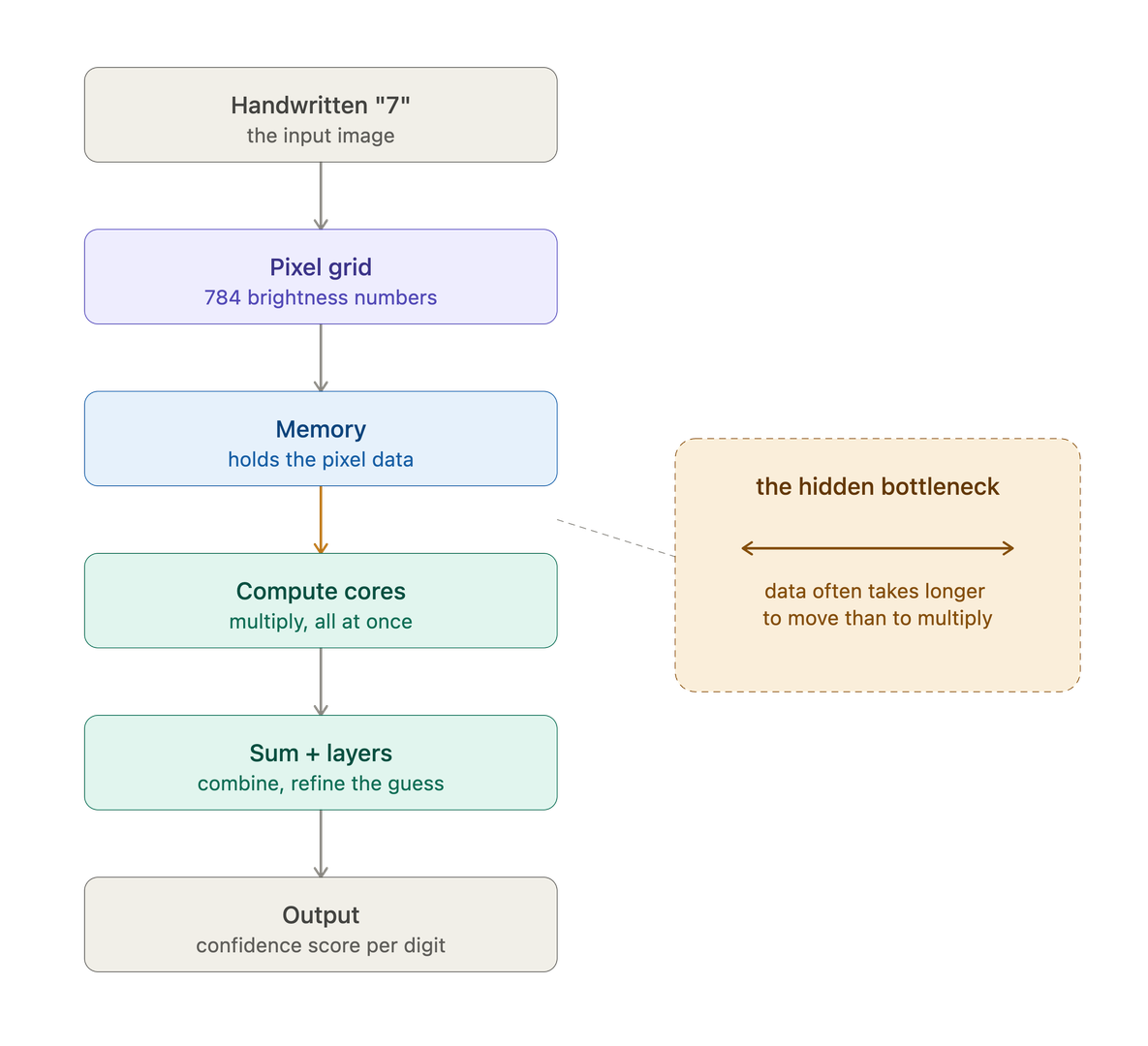
Unlike CPUs, AI chips have thousands of small, simple cores placed precisely in a small semiconductor chip. This is essential for parallel processing, the biggest difference between a regular and an AI chip. But before these cores run anything, data needs to travel from memory to them. This data movement is a real cost. In fact, in some complex workloads, moving the data takes longer than multiplication itself. Besides cost, this also results in more environmental damage because of the carbon footprint of inference.
That’s why many designers of even the top AI chip companies focus more on memory bandwidth rather than simply adding more cores for processing.
Once the memory reaches the cores, they start computing the tasks. To make things much faster, these chips work on low-precision numbers, like 16-bit or 8-bit, instead of 32-bit. The reason is simple. Neural networks can handle some imprecision, so bit sizes are reduced for faster and cheaper calculations.
Here’s a visual walkthrough of how this works in steps within seconds. To keep things simple, I have shown a visual representation of an AI chip recognizing a handwritten digit. By the way, that’s something even a standard chip should be able to do.
How AI Chips Are Different From Normal Chips
In layman’s terms, the most basic difference is that one can facilitate AI tasks, while the other cannot. And the demand for these chips that can process AI computations is growing. Behind every small development in AI technology are huge leaps in computing power. The New York Times has reported research by Epoch AI claiming that the number of AI chips used by AI data centers could rise tenfold from 20 million currently to 200 million by the end of 2028.
“This is the largest scale infrastructure build-out in the history of humanity.”
Per Rob Wachen, co-founder of Etched.
So you can simply refer to AI chips as advanced versions of regular GPUs. But there’s a lot of difference between the two. For instance, they have different design philosophies for completely different jobs. Listed below are some key differences between a regular GPU and an AI chip:
- Parallel Processing: The biggest difference you will find in a normal chip vs. an AI chip comparison is parallel processing. As explained earlier, a CPU might have a few cores that run complex tasks one at a time. On the contrary, an AI chip has thousands of smaller cores that can run simpler tasks simultaneously, over and over.
- Speed: For a single instruction, a CPU is faster than artificial intelligence chips. But when it comes to AI workloads that require millions of repetitive calculations, CPUs become significantly slower, which raises the need for custom chips designed for these tasks.
- Performance and efficiency: Chips designed for machine learning computation are built to extract the maximum amount of useful computation from every watt of power. Thus, they can perform artificial intelligence tasks while consuming less energy and other resources. But while AI chips are efficient per computation, the enormous number of times they compute results in eight to ten times more power usage than a CPU.
- Memory: CPUs are paired with high-capacity, low-latency memory because they need to handle general tasks, such as running software. Artificial intelligence chips, by contrast, have higher memory bandwidth. The aim here is to increase the rate at which data flows between memory and cores.
- Cost: AI chips are way more expensive than CPUs, especially right now due to high demand and very few companies manufacturing them. Therefore, cost is one reason AI companies are building their own chips. They don’t have to rely on a few manufacturers and can bring down AI chip prices.
- Flexibility: This is a tradeoff, as CPUs win decisively here because they can perform wider purposes, such as running an operating system, a video game, or a web browser. Put simply, it is the brain that runs the machine itself. An AI chip, however, is a specialist that excels at matrix math but can’t perform multiple general tasks. Therefore, manufacturers deploy it alongside a CPU, with the CPU handling broader tasks and the AI chip serving as an accelerator that kicks in only for AI-specific processes.
Types of AI Chips
Unlike CPUs, AI chips are for task-specific processing. However, they could still perform multiple tasks based on the underlying architecture. Not all chips are equal, and the right choice could depend on project goals. Here are a few types of AI chips commonly in use today:
Graphics Processing Units (GPUs)
Anyone who plays video games knows the importance of GPUs for quality graphics. But while GPU chips were initially designed for rendering video game graphics, their immense parallel processing abilities make them an ideal choice for artificial intelligence tasks. Today, GPUs, especially the ones built by NVIDIA, are the dominant chips for training and running AI models.
- Pros: Extremely flexible, huge software ecosystem (CUDA), widely available
- Cons: Power-hungry, expensive, not the most efficient option for a specific fixed task
Tensor Processing Units (TPUs)
Think of TPUs as AI chips supporting deep learning and neural networks. Google has designed them specifically for high computation. Therefore, TPUs can strip out data not required to perform a task, thereby increasing efficiency.
- Pros: Very efficient for the specific workloads they’re built for, especially within Google’s own ecosystem
- Cons: Less flexible, mainly accessible via Google Cloud
Neural Processing Units (NPUs)
These are again deep learning chips for processing the large volumes of data and math required by deep learning. TPUs are well known for their natural language processing (NLP) capabilities and their use in edge AI devices. They can facilitate AI tasks such as face recognition, photo enhancement, and more locally.
- Pros: Extremely power-efficient, enables on-device AI (privacy + speed benefits)
- Cons: Much less powerful than data-center chips; can’t train large models
Field-Programmable Gate Arrays (FPGAs)
Field-programmable gate arrays bring flexibility to the otherwise rigid world of task-specific AI chips. Unlike other chips, these have a unique design that makes them reprogrammable at the hardware level. They are made of interconnected logic blocks that make them more customizable than others.
- Pros: Reconfigurable, good for specialized or evolving workloads
- Cons: Harder to program, generally less raw performance than GPUs for AI
Application-Specific Integrated Circuits (ASICs)
As the name suggests, these are built specifically for one particular application. Companies build ASICs once they know the exact AI workload they have to handle to reach their goals.
- Pros: Maximum efficiency for the specific task it’s designed for
- Cons: Zero flexibility (if your needs change, the chip is essentially obsolete)
The table below compares the different types of AI chips:
| Chip type | Flexibility | Efficiency | Typical use | Example |
| CPU | High | Medium | Training and running large language models | Nvidia H100 |
| TPU | Low-medium | High | Google’s own AI infrastructure | Google TPU v5 |
| NPU | Low | Very high | Edge device AI | Apple Neural Engine |
| FPGA | High | Medium high | Specialized or evolving workloads | Xilinx/AMD FPGAs |
| ASIC | Very low | Very high | Fixed, high-volume task | Custom inference chips |
The Need for AI Chips
Mordor Intelligence estimates the global AI chipset market at $70.25 billion in 2026. The market report indicates it could grow at a CAGR of 32.41% between 2026 and 2031 to reach a whopping $285.9 billion.
A CAGR of over 32% is proof enough of the demand and need for AI chips. And one of the key contributors to this growth is the sheer scale of AI workloads. While earlier AI models were simple enough to train on standard CPUs, the current ones are not. The advent of generative AI has changed that landscape, as training a single large language model can require more computational resources than the total number of observable stars in the universe.
Real-time outputs and low-latency requirements further drive this demand. Take, for example, Level 5 autonomous vehicles. While most vehicles use LiDAR technology, Elon Musk says that high-resolution cameras and artificial intelligence are all that vehicles need to become driverless. But to make that possible, the underlying AI chip should be fast enough to make decisions in split seconds to avoid accidents.
The same goes for conversational AI agents responding to customer queries. There’s also a growing use of on-device artificial intelligence. For instance, your personal devices like smartphones, desktops, or laptops transmit sensitive information to the cloud for certain activities. This can compromise security, which has led to a need for on-device processing. To meet this demand, engineers are now developing edge AI chips. What these edge computing AI chips do is process data locally on the device to avoid the need to send it to the cloud and wait for a response.
CPUs can only process these tasks sequentially, which introduces lag for multiple calculations. Thus, they become unreliable at making the quick decisions required by artificial intelligence systems. Even AI chip progress can plateau at some point, and another breakthrough might be required, creating a need for a better design or architectural change.
Top AI Chip Companies in the Market
Most tech companies are competing to overcome the current limitations of AI and be the first to enter the era of artificial general intelligence (AGI). The demand for compute is, therefore, ever-increasing. The result is a fierce AI chip race among the top tech companies. NVIDIA, for instance, is currently the leader in the field with its wide-purpose chips like H100 and H200.
But there are many other AI chip companies in this race. OpenAI recently unveiled Jalapeño, an AI inference chip designed in association with Broadcom. Then there’s Meta, which is investing in custom chips, while Microsoft has its Maia chip family. IBM has introduced its sub-1 nanometer chip. Anthropic, meanwhile, is reportedly exploring something of its own.
These chips aren’t intended solely for technology companies working on artificial intelligence breakthroughs. NVIDIA is bringing them to personal laptops and desktops, too. In fact, the company refers to its GDX Station powered by NVIDIA Grace Blackwell as a deskside AI supercomputer. On May 31, 2026, the company also announced an AI-chip-powered Windows PC in partnership with Microsoft.
“The PC is being reinvented. For forty years, you launched apps. Click. Type. With RTX Spark and Microsoft Windows, you ask — and the PC does the work. RTX Spark brings everything NVIDIA has built — CUDA, RTX, our AI platform — into a single superchip. Local agents. Frontier models. Creative workflows. RTX games. All on a laptop. This is the new PC. The personal AI computer.”
Said Jensen Huang, founder and CEO of NVIDIA.
Given below is a list of the best AI chip companies and their most reputed products so far:
| Company | Chips | Positioning |
| NVIDIA AI chip | H100, H200, Blackwell Series | The dominant general-purpose leader; broadest software ecosystem (CUDA) |
| AMD AI chip | Instinct MI300 series, Ryzen AI | Nvidia’s main data-center competitor; Ryzen AI brings on-device NPUs to AMD laptop chips |
| Google AI chip | TPU v4/v5 | Custom-built TensorFlow AI chip for Google’s own cloud and AI stack |
| Intel AI chip | Gaudi series | Lower-cost training/inference alternative; built on technology from its acquisition of Habana Labs |
| Amazon AI chip | Trainium, Inferentia | Custom chips to reduce AWS’s dependence on Nvidia |
| Apple AI chip | Neural Engine (in-device) | On-device AI for privacy and speed, not data-center scale |
| Qualcomm AI chip | Snapdragon NPUs | On-device AI for Android phones |
| IBM AI chip | Telum, AIU (Artificial Intelligence Unit) | AI acceleration built into enterprise mainframes and hybrid-cloud infrastructure |
| Cerebras AI chip | Wafer-Scale Engine (WSE) | Builds the largest single chip in the industry aimed at training very large models without splitting work across many separate chips |
| SambaNova | RDU (Reconfigurable Dataflow Unit) | Targets enterprise AI with a reconfigurable architecture designed to adapt to different model types without redesigning hardware |
Future of AI Chips
Researchers are planning not just for artificial general intelligence, but artificial superintelligence, too. While both these levels of AI are still a distant future, this growth reflects the increasing demand for technology. As demand grows, current AI chips may no longer be able to keep up with speed amid increasing complexity.
- Neuromorphic computing chips: A neuromorphic chip refers to ICs that are designed to mimic the structure of human brains. Just as brains transfer data and signals from one neuron to another through bursts of activity, a neuromorphic computing chip uses spiking signals. They aim for radically better energy efficiency for certain tasks.
- Optical/photonic computing: Light can be faster than electricity and doesn’t require any medium like wires to travel. So, some researchers are trying to deploy those benefits using an optical CPU to perform calculations at a faster rate through photonic processors.
- Chiplet architectures: Instead of a single microchip, designers use multiple smaller chiplets. This chiplet-based architecture improves manufacturing yield and flexibility.
Conclusion
AI chips aren’t just advancements in artificial intelligence hardware. They are the very base of what makes several AI tasks successful. But this does not end here. They will continue to evolve through new architectures, efficiency breakthroughs, and increased competition. Researchers are even looking for quantum chip breakthroughs to gain the utmost level of processing speed.
But the challenge is that most companies and governments cannot keep up with the speed at which artificial intelligence is developing. From inadequate infrastructure to a lack of governance, there’s a lot businesses and governments need to address before we move into the next phase of artificial intelligence and AI chips.
Frequently Asked Questions
It depends on what AI tasks you want to perform because simple activities don’t require a dedicated AI chip or GPU. For example, you can use ChatGPT for generative AI work without a specialized chip. But it’s a completely different thing when you want to run your own large language model (LLM). In such a case, having a GPU will affect the speed and computational power.
GPUs are flexible as they are built to serve multiple purposes. Even a standard system that does not run AI tasks but needs gaming prowess would require a GPU. Despite that flexibility, GPUs prove to be great for AI-specific tasks. On the other hand, engineers built TPUs from the ground up with a primary focus on neural network math. They trade flexibility for efficiency.
While it is true that most AI chip companies are large multinationals, they are also relevant for personal use cases. That’s because training AI models requires substantial resources, which usually only giant tech companies have to build their own artificial intelligence chips. However, end users may also need AI inference chips on their devices.
A combination of factors has led to the rising AI chip price. The biggest contributor is the surge in demand, which has skyrocketed due to the generative AI boom. Similarly, competition is low today because only a handful of AI chip companies are building them, given the technical difficulty of designing and producing cutting-edge chips.