The History of Artificial Intelligence

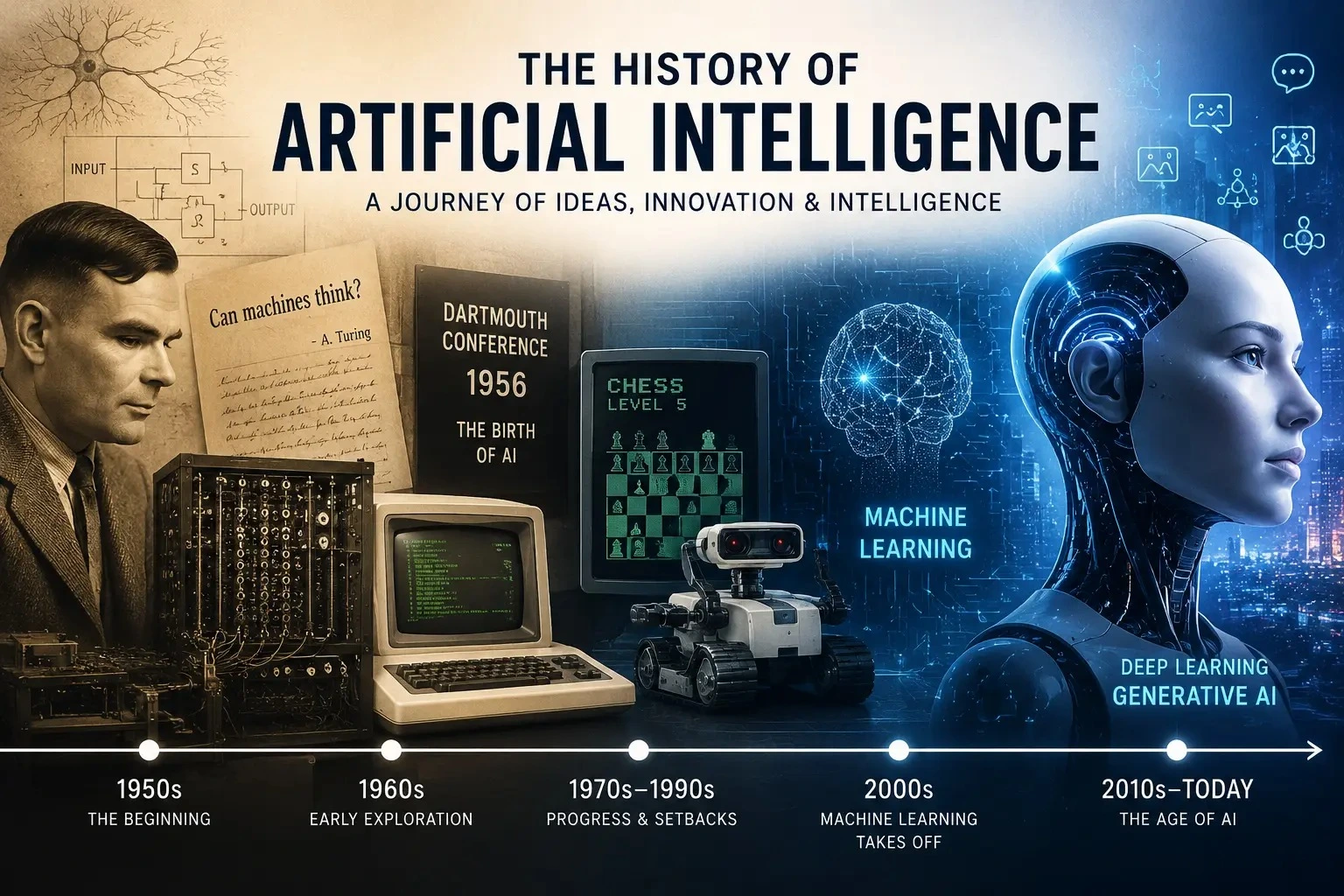
Artificial intelligence (AI) is often presented as a sudden breakthrough, but its current capabilities are the result of more than seven decades of steady progress, setbacks, and paradigm shifts. Understanding how we moved from rule-based systems to GPT-style large language models helps clarify both the power and limits of today’s AI.
From the first symbolic programs and expert systems to deep learning and transformer architectures, each generation of AI tried to fix flaws in the last. This historical arc is crucial for creators, engineers, and policy‑makers who must decide how to use, regulate, and build on these systems.
Early Foundations
The conceptual roots of AI trace back to mid‑20th‑century ideas about computation and intelligence, especially Alan Turing’s proposal of a test for machine intelligence in 1950. In 1955, John McCarthy coined the term “artificial intelligence,” formally defining a field focused on creating machines that could perform tasks requiring human intelligence.
Early systems favored a “top‑down” approach known as symbolic AI or “good old‑fashioned AI” (GOFAI). Researchers attempted to encode human reasoning directly using logic, mathematical formalisms, and symbolic representations of knowledge about the world.
The Era of Rule-Based Systems and Expert Systems
From the 1950s through the 1980s, rule-based systems were the dominant paradigm. These systems relied on explicit IF–THEN rules, symbolic reasoning, and carefully hand‑crafted knowledge bases to mimic the decisions of human experts. A classic example is the rise of expert systems in the 1980s, including commercial systems like XCON, which configured computer hardware at scale using thousands of rules.
Medical expert systems followed similar logic: “If a patient has fever and cough, then consider flu,” encapsulating expert heuristics into software. By the mid‑1980s, expert systems represented a booming industry, with corporate investments estimated in the hundreds of millions of dollars annually as companies deployed rule-based AI for logistics, configuration, and diagnostics.
Limits of Rule-Based AI and the First AI Winters
Despite early enthusiasm, rule-based systems revealed significant weaknesses. They were brittle: small gaps or contradictions in the rule base could cause failures, and maintaining thousands of rules quickly became unmanageable. Moreover, these systems struggled with uncertainty and learning; they could not easily improve from new data or adapt to novel situations outside their pre‑coded rules. As expectations outpaced results, funding cuts in the 1970s and late 1980s triggered “AI winters,” periods when the field was widely seen as overhyped.
The Turn Toward Learning
In response, researchers began shifting focus from hand‑crafted rules to systems that could learn patterns from data. This “bottom‑up” approach aimed to replace explicit knowledge encoding with statistical learning and optimization. Early machine learning methods included decision trees, statistical classifiers, and simple neural networks. Instead of writing rules for every scenario, engineers trained models on labeled examples so the system could infer decision boundaries and generalize to new inputs.
Neural Networks and the Deep Learning Breakthrough
Neural networks, loosely inspired by biological neurons, were first explored in the 1950s and 1960s, but their full potential took decades to materialize. The development of backpropagation and multilayer networks in the 1980s provided a framework for learning complex non‑linear functions from data.
The deep learning revolution accelerated in 2012, when AlexNet, a deep convolutional neural network, dramatically outperformed rival methods in the ImageNet challenge, cutting the error rate roughly in half compared with the next best system. This moment convinced much of the AI community to embrace deep learning and GPU‑accelerated training as the new baseline.
Sequence Models
As deep learning matured, new architectures emerged for handling sequential data like language. Recurrent neural networks (RNNs) and their improved variant, long short‑term memory (LSTM) networks, could maintain hidden state over time, making them suitable for speech recognition, translation, and text generation.
However, RNNs still struggled with long‑range dependencies and parallelization, limiting their ability to capture relationships across long sentences or documents. This set the stage for attention mechanisms, which allow models to focus selectively on different parts of an input sequence when generating outputs.
The Transformer Architecture and Pretraining
In 2017, the paper “Attention Is All You Need” introduced the transformer architecture, which replaced recurrent structures with self‑attention and positional encoding. Transformers scale efficiently across large datasets and hardware, and they can model long‑range dependencies by attending to all tokens in a sequence at once.
Alongside transformers, researchers popularized the idea of pretraining large models on massive unlabeled corpora, then fine‑tuning them on specific tasks. This approach, known as transfer learning, allowed one general model to power many applications, from translation to question answering.
Enter GPT
OpenAI’s GPT series exemplifies the marriage of transformers and large‑scale pretraining. GPT‑1 and GPT‑2 demonstrated that generative models trained on billions of tokens could produce coherent text, though their capabilities were still limited compared with today’s systems. GPT‑3, launched in 2020, dramatically expanded scale and performance, using 175 billion parameters and training on a vast corpus of internet text. This model could perform a wide range of language tasks like translation, code generation, creative writing, and dialogue with little or no task‑specific fine‑tuning, relying instead on prompt‑based control.
What Really Changed?
The shift from rule-based systems to GPT-style models reflects three fundamental changes in how we build AI.
- First, knowledge moved from explicit rules to learned representations. Instead of encoding expert logic, we train models on vast corpora so they infer statistical regularities and latent structures directly from data.
- Second, scale and compute became central. GPT‑class models rely on massive datasets, billions of parameters, and specialized hardware, enabling them to approximate complex functions of language that were unimaginable in the expert‑system era.
- Third, flexibility improved. While rule-based systems were narrowly tailored to specific domains, GPT models can be steered via prompts to perform diverse tasks without rewriting rules, giving them broad applicability in content creation, customer support, coding assistance, and more.
Implications for Creators, Businesses, and Society
For content creators, developers, and businesses, the evolution of AI changes both workflows and expectations. GPT‑style systems can accelerate drafting, brainstorming, translation, and data summarization, while earlier rule-based tools remain useful for highly structured, constrained decision tasks.
At the same time, reliance on data-driven models raises questions about bias, hallucination, data governance, and environmental cost, all of which differ from the concerns around rule-based expert systems. Understanding this history helps stakeholders design hybrid systems and governance frameworks that combine automation with human judgment.
Looking Ahead: Beyond Today’s GPT
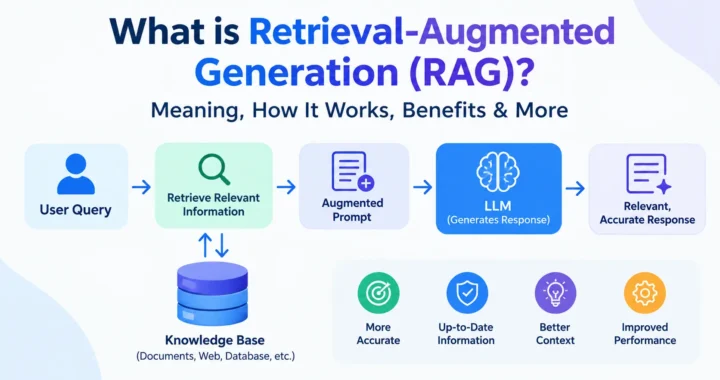
Current GPT models are not the end of the story; they are milestones in a continuing trajectory. Research now explores techniques such as retrieval‑augmented generation, multimodal models that handle text, images, and audio, and more efficient architectures that reduce compute demands.
Future systems may blend symbolic reasoning, external tools, and learned representations, effectively closing the loop between the rule-based roots of AI and its modern statistical incarnations. For practitioners, tracking these shifts is essential to remain strategic about which AI capabilities to trust, adopt, or challenge.
FAQs
How do AI winters influence today’s AI investment strategies?
AI winters taught policymakers and investors that hype cycles can lead to overinvestment followed by sharp pullbacks when expectations are not met. As a result, many organizations now emphasize incremental deployment, measurable ROI, and diversified research portfolios to avoid repeating past boom‑and‑bust patterns.
Are rule-based systems still used in modern AI applications?
Yes. Rule-based and expert systems remain common in domains that require deterministic behavior, strict compliance, or transparent logic, such as tax software, safety‑critical checks, and some medical decision support tools. They often work alongside machine learning models in hybrid architectures that combine reliability with adaptability.
How did hardware advances make large models like GPT feasible?
Progress in GPUs, specialized accelerators, distributed training frameworks, and cloud computing made it possible to train models with hundreds of billions of parameters. Without these hardware and infrastructure advances, the computational cost of training GPT‑scale models would have been prohibitive.
Could future AI systems reintroduce symbolic reasoning at scale?
Many researchers are exploring neurosymbolic approaches that combine neural networks with explicit symbolic reasoning or external knowledge bases. Such hybrid systems aim to preserve the flexibility of learned representations while gaining the logical rigor and interpretability associated with symbolic AI.