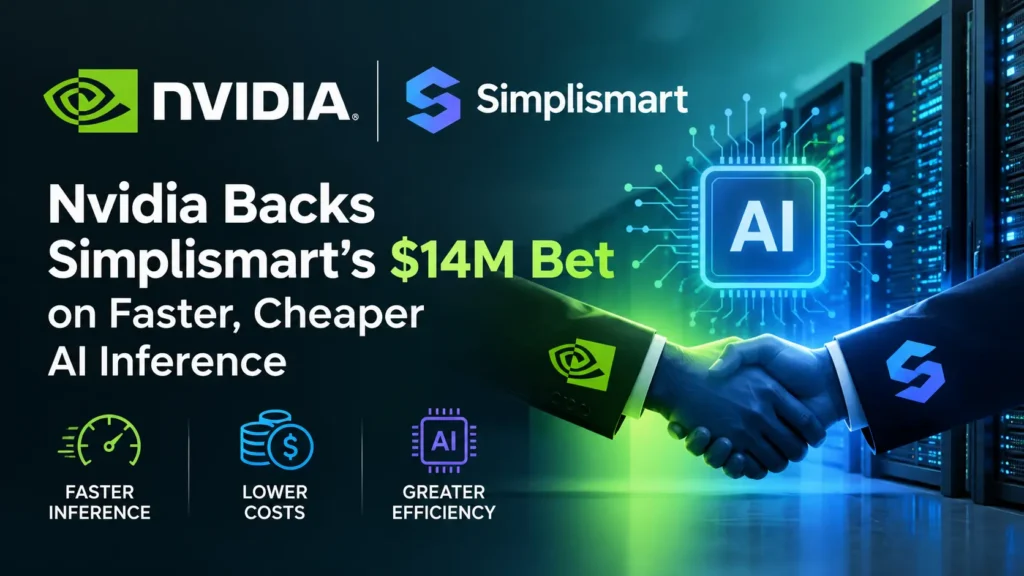
Nvidia Backs Simplismart’s $14M Bet on Faster, Cheaper AI Inference

In August 2026, Nvidia backed Sarvam. The company raised $74 million from Nvidia, Glade Brook Capital, Activate, and Gaja Capital. In just two months, Nvidia has backed another Indian AI infrastructure startup, Simplismart, as the race to make AI cheaper and greener heats up.
On October 27, 2026, the Bengaluru-based company raised $14 million in Series B funding led by Dallas Venture Capital. Nvidia, Accel, Shastra VC, and Micromax backed the company’s platform. This deal puts Simplismart’s valuation at $100 million.
Simplismart bills itself as the fastest platform for AI inference and deployment. But what makes Simplismart cheaper?
What Does Simplismart Actually Do?
Training an AI model gets the headlines. But inference, the everyday work of answering your prompts, is where the money and electricity go. That’s what the Bengaluru-based company works on.
Simplismart’s pitch is that inference is a spectrum, not a leaderboard. Different workloads require different resources. The platform tunes batching, caching, precision, and scheduling around each workload.
“Nobody actually needs the fastest or the cheapest inference,” Amritanshu Jain, co-founder and CEO of Simplismart, said in an interview covered by TechCrunch.
Instead, companies should focus on running AI models at speeds and costs that make sense for them. For instance, an AI-based chatbot needs instant responses, while administrative tasks can wait a few minutes or hours, depending on the need.
What Simplismart does is focus on optimizing this inference process based on workloads. The result is fewer GPU requirements, which ultimately increases speed and brings down the total cost of ownership.
Founded in 2022 by Devansh Ghatak and Amritanshu Jain, Simplismart is not associated with Nvidia on the financial terms alone. Engineers at Simplismart are also working with Nvidia’s solution architects on their own infrastructure for technical integrations.
“Where we tend to win is where people have to be more stringent on their SLAs [service-level agreements] and TCO [total cost of ownership],” Jain added.
Why Inference Efficiency Matters
Inference efficiency matters not just financially, but also from an environmental standpoint.
The International Energy Agency projects global data-center electricity use could reach about 945 TWh a year by 2030. This is up from roughly 485 TWh in 2025. This massive surge in energy demand is driven by the artificial intelligence boom.
Training an AI model requires significant upfront energy. But when you factor in the back-and-forth interactions between a user and an AI model, inference energy consumption adds up to much more in the long run.
In fact, inference already accounts for roughly 80-90% of AI computing today. That is one of the biggest drivers of artificial intelligence’s environmental impact.
That makes inference the biggest lever for both cost and carbon. A GPU that sits idle, or a model that wastes compute on every request, still draws power. Squeezing more useful work out of each chip means less hardware and less energy for the same output.
One caveat is worth stating. Cheaper AI tends to mean more AI being used, so efficiency alone won’t shrink the total footprint. It lowers the cost and energy of each query, which is a good starting point. Simplismart CEO Amritanshu Jain argues that cheaper inference can make an AI product viable, not just shrink its bill.
Other Similar Projects on Inference
AI inference efficiency has become a crowded and well-funded race.
One of the biggest projects in that space is llm-d 1.0. Founded in 2025 by Red Hat, IBM, Google Cloud, CoreWeave, and Nvidia, the open-source project is now governed by the Cloud Native Computing Foundation (CNCF).
It reports demonstrations of up to five to 10 times cost reductions for context-heavy agentic workloads. IBM Research reports 11.5 times lower inference cost than an all-proprietary setup on a quantum-error-correction chip design project.
“AI inference is quickly becoming a core cloud native workload. llm-d 1.0 helps organizations meet this shift at scale by bringing together open source inference capabilities with the requirements that matter in scaling production to then meet the demands of agentic workloads. It’s an important step toward making high performance open source inference more operationally mature and accessible across the cloud native ecosystem.”
said Chris Aniszczyk, CTO, CNCF.
Similarly, Baseten and Inferact are in the space. Both startups are working to lower inference costs. The inference startup raised a $1.5 billion Series F in June 2026. It was completed at valuations of $11 billion and $13 billion.
What’s Next for Simplismart?
Simplismart plans to use the funding to deepen its inference engine and orchestration platform. It also aims to expand cloud partnerships, with North America being a priority. The company is also working toward a scheduling layer that matches demand with spare GPU capacity across regions while respecting data-residency rules.
Nvidia’s backing signals that the next phase of AI won’t be won by bigger models alone. Whoever runs them best will win, and an Indian startup now has a seat at that table.