If AI Takes Over Entry-Level Jobs, How Will Someone Become an Expert

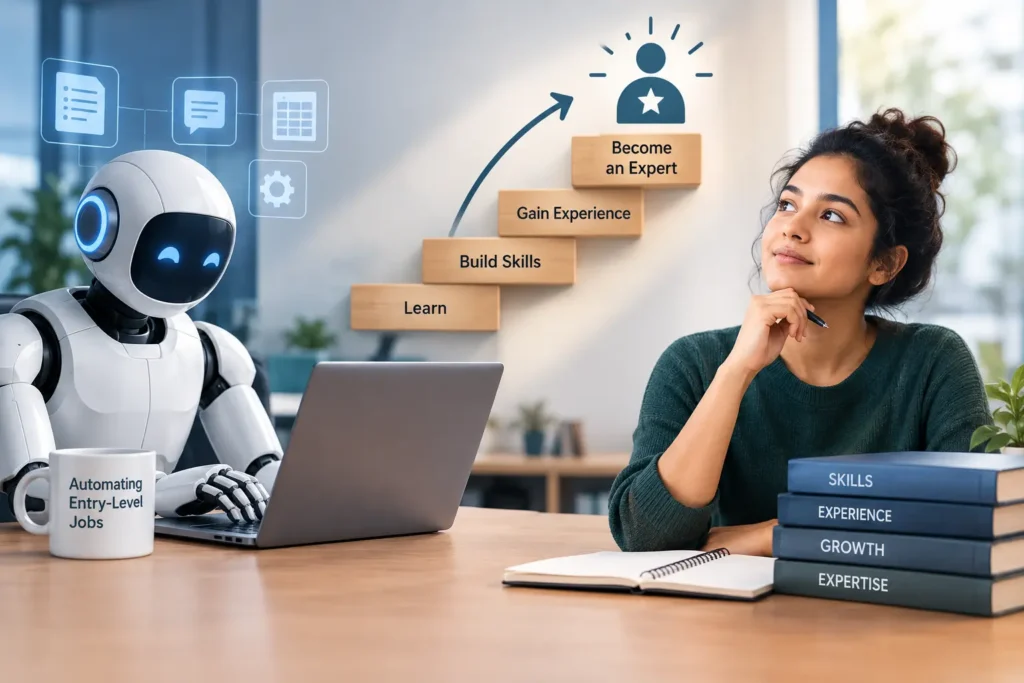
Artificial Intelligence (AI) is taking over entry-level work, and there’s no denying that. But it is also rewriting what it takes to become good at something.
Here is a story that sounds like satire. 404 Media reported that some people paid to improve ChatGPT were reportedly fired for using AI to do their jobs. A contractor told 404 Media that many people use AI all the time and get kicked off for it.
The report says workers were removed for using tools such as GPTZero, Grammarly, and AI translation while completing their tasks. The reasoning is simple. If a model learns from feedback written by another model, it stops learning from people. This changes the training pipeline, which could affect the quality of responses generated by artificial intelligence models.
Put simply, the industry that tells every office to adopt AI has drawn a firm line around its own most important work. For that work, it wants a human who thought it through personally.
The rate at which AI takes over entry-level jobs will certainly increase with the boom in agentic AI. Agents can think for themselves to complete the task at hand. This makes them ideal for automating tasks and processes that require minimal human input.
But this raises an important question. If AI takes over entry-level jobs, will someone be able to master a skill well enough to reach such an advanced level of expertise? For example, someone just entering the content writing field would now have access to powerful tools like Claude, ChatGPT, Gemini, and others. In that case, will they ever reach the same mastery as human writers from the non-generative AI era?
The Ladder Seems to Be Missing Its Bottom Rung
The thing is that nobody is born with good judgment. A junior lawyer learns what matters in a contract by reading hundreds of dull ones. Similarly, a junior developer learns what clean code looks like by writing messy code and watching it break.
Entry-level work was never only about output. It was more like a paid practice. The first drafts, first-pass reviews, and boring spreadsheets built the instincts that make experience valuable.
Those are also the tasks AI handles fastest and cheapest. A manager facing a tight quarter has an obvious option. Why hire a junior and spend months training them when a tool produces a decent draft in seconds?
Any one company that makes that choice looks rational. Added up across an industry, it creates a problem. Today’s experts exist because someone once let them be mediocre at the basics. If every company skips that stage, we will have plenty of people who can prompt a tool and very few who can tell when it is wrong.
California has now drawn a similar boundary from the legal side. On September 30, 2026, Governor Gavin Newsom signed a package of bills governing how AI is used to discipline, monitor, and lay off employees. It prohibits employers from relying solely on automated decision systems to discipline or terminate workers. The measure began as a revised version of last year’s “No Robo Bosses Act,” which Newsom vetoed.
No worker should ever be fired or disciplined by a robo boss. Artificial intelligence systems have the potential to increase productivity, but they’ve also been prone to errors, bias, and misjudgments. The governor’s signing of SB 947 ensures human oversight of AI in the workplace. AI must remain a tool controlled by humans, not the other way around.
Said Senator Jerry McNerney, D-Pleasanton.
I know that the law is about firing, not training. But the principle underneath is the same. Some decisions carry enough weight that a person who understands the work must be accountable for them. That is hard to meet if the people who understand the work were never allowed to learn it.
But Maybe We Are Asking the Question the Old Way
So far this sounds like a warning, and it partly is. But I think the question hides two assumptions that deserve a second look. The first is that every entry-level skill is worth mastering. The second is that the way people became experts in the past is the only way to do it.
Not every rung deserves saving. The World Economic Forum’s Future of Jobs Report 2025 draws on more than 1,000 employers representing over 14 million workers across 55 economies. It projects that 170 million new jobs will be created by 2030, while 92 million will be displaced, for a net gain of 78 million. Together, creation and displacement amount to about 22% of today’s jobs.
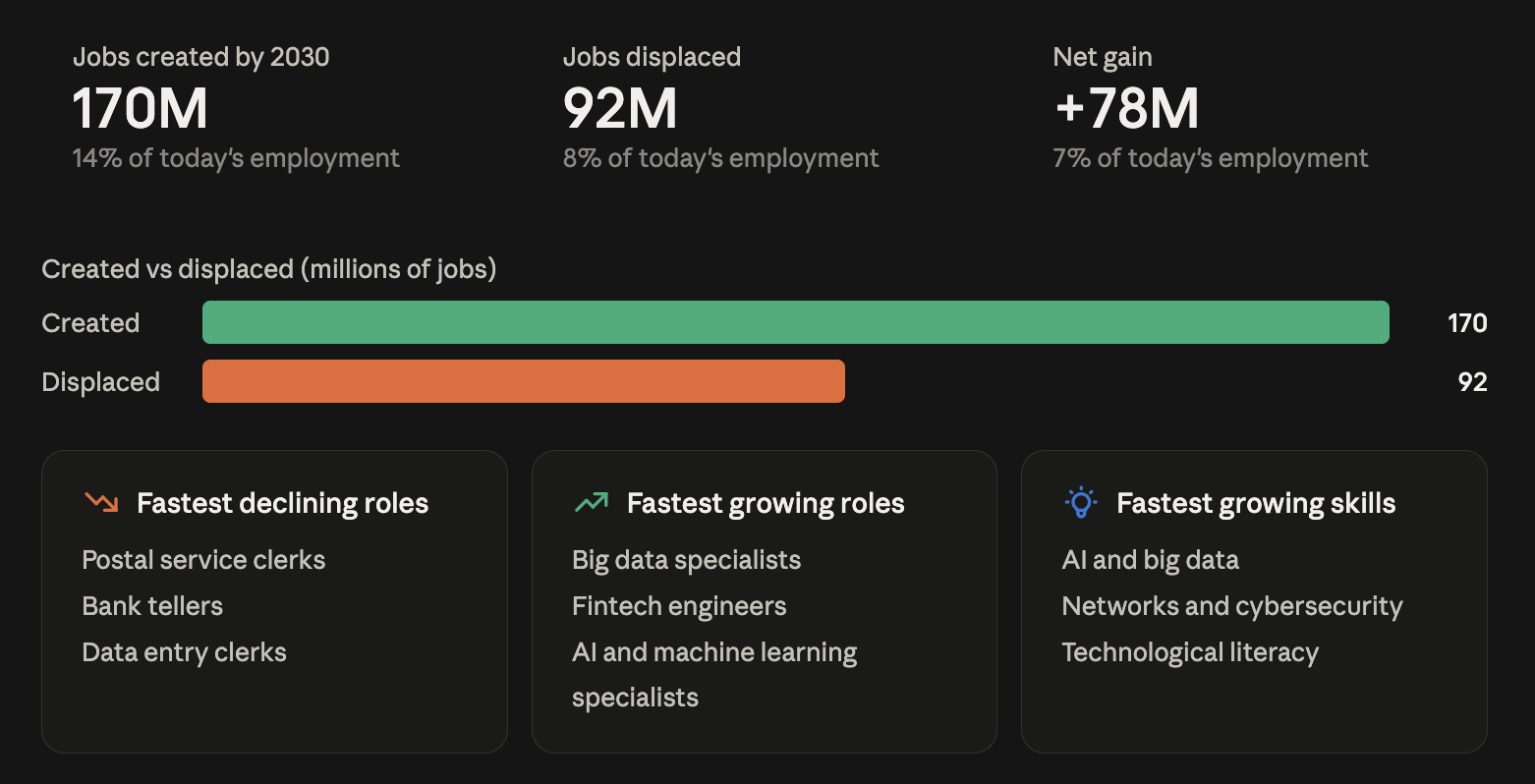
Source: World Economic Forum, Future of Jobs Report 2025
Look at what’s declining. The fastest-declining roles include postal service clerks, bank tellers, and data entry clerks. These are routine, repetitive jobs.
Ask yourself how many people dream of becoming a world-class data entry specialist. Almost nobody does. These were never apprenticeships toward mastery. People did them to earn a living. One summary of the report estimates that about 39% of today’s skills will be outdated by 2030. If a skill is on its way out, it’s better to spend that effort mastering something else.
Another important point I want to highlight is that the path to mastery is being rebuilt, not deleted.
Artificial Intelligence is not eliminating the path to becoming an expert or masting a skill, it is simply changing the place where we start and how we take on that journey.
AI, big data analytics, networks and cybersecurity, and technological literacy are in high demand right now. The fastest-growing jobs include big data specialists, fintech engineers, and AI and machine learning specialists. None of these has a traditional ladder. No one is becoming a senior AI-collaboration expert after spending twenty years in the mailroom.
Many people picture a future where humans and AI work side by side. If that is right, then mastery in that world starts with working alongside AI.
That is how earlier generations learned spreadsheets and search engines. They used them every day until they could tell a good result from a bad one. The apprenticeship doesn’t vanish. It moves to a new place.
What the People Building AI Say
The leaders closest to the technology disagree on pace and scale, but their views support this picture.
At the Milken Institute Global Conference 2025, Nvidia’s Jensen Huang said that AI will affect every job, and he says it will happen immediately.
Every job will be affected, and immediately. It is unquestionable. You’re not going to lose your job to an AI, but you’re going to lose your job to someone who uses AI.
Said Jensen Huang.
This suggests that AI will take over entry-level jobs and affect many higher-level roles, too. But it does not necessarily mean that you will lose your job.
Andrew Ng, founder of Google Brain and Coursera, argues that the panic is overstated. At Davos in January 2026, he said, “Job loss related to AI to date has been overhyped.”
He argues that jobs are bundles of tasks. For many jobs, he says, AI can handle only 30 to 40 percent of the work for the foreseeable future, leaving most of it to people. The result is a shift in what skill means. Someone who uses AI becomes more productive than someone who doesn’t.
“In fact, many companies just can’t find enough skilled AI talent,” NG wrote in an X post.
Where This Argument Gets Hard
I don’t want to overstate the optimism, because the hard case is real. Dario Amodei, Anthropic’s CEO, has warned that AI could take over half of all entry-level white-collar jobs within five years and push unemployment to 10%-20%. He pointed to technology, finance, law, consulting, and other professional services as especially exposed at the junior level.
Those are not data entry jobs. Those are fields where people do want deep expertise, and where juniors have always learned by doing the grunt work. In those fields, the missing-rung problem becomes genuine.
My argument that nobody wants to master the old skill doesn’t apply to a junior associate who needs to learn to read a contract. But the point about the changed path to mastery is still valid here.
There is also a learning trap. Many reports have noted that overreliance on generative AI can affect critical thinking, creativity, memory, and job-specific skills.
Research suggests that excessive reliance on AI may weaken these abilities when people passively accept its answers instead of engaging in independent reasoning, problem-solving, and learning. A new hire who lets the model do every task may produce good work and learn nothing.
However, research also shows that using AI strategically can improve creativity, productivity, and decision-making. This is particularly true when users evaluate its output and apply their own knowledge and judgment.
So the answer here is the appropriate use of artificial intelligence.
We cannot ban AI from entry-level work. That would be impractical at this stage, as its influence will only continue to rise across industries and professions. But we can be deliberate about it.
Employers can treat junior work as a training investment rather than only a cost to cut. Similarly, early-career workers can use AI as a tutor rather than a substitute.
We should try the problem ourselves first, then ask the tool where we went wrong. If we can’t explain why an answer is correct, we haven’t learned it yet, no matter how polished the output looks. Don’t spend years mastering a skill the market is retiring; put your energy into skills that are growing.
Schools and training programs also need to teach for the jobs that are arriving. They need to teach students to work with AI without handing over their thinking.
The rest of us should notice what the biggest AI labs are doing. When they insist on real human judgment for the work that matters most, they are telling us what they expect to stay valuable.
The Question to Leave With
The old ladder is shrinking. Some of its rungs, like data entry and routine administration, were never worth fighting for. Others, like the junior years in law, finance, and consulting, are where real expertise has always been built, and we can’t afford to lose them by accident.
The question is no longer how anyone becomes an expert if AI takes over entry-level jobs. It is who is building the new on-ramp, and whether we will do it on purpose before we notice the gap.