What Does NVIDIA’s Almost $13 Billion Bet on Hugging Face Mean for the Future of Open AI

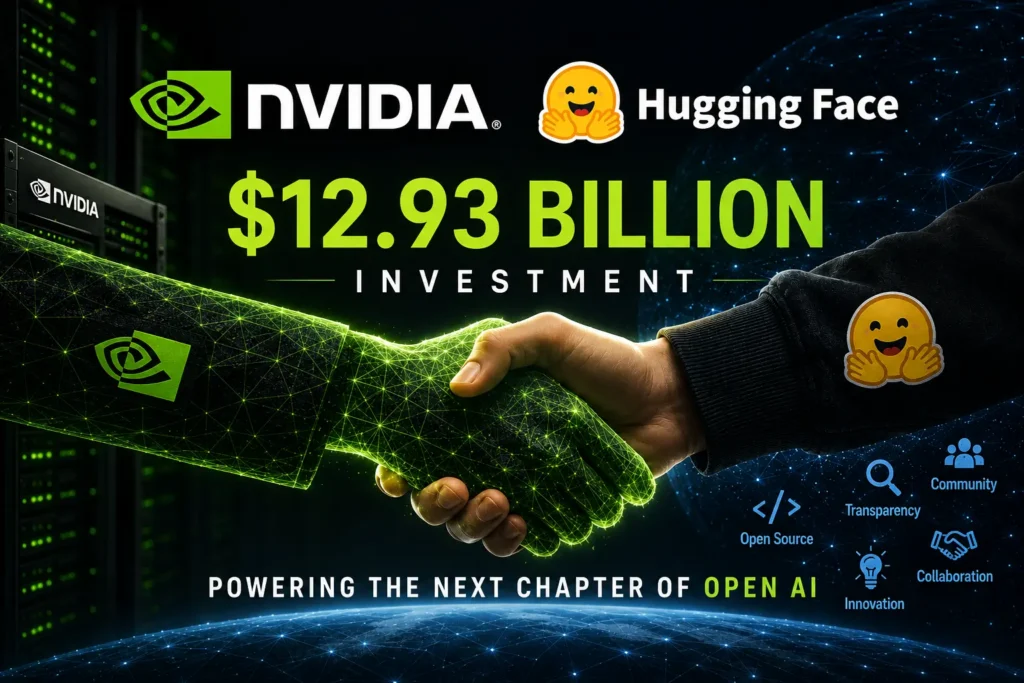
NVIDIA, the world’s most dominant supplier of graphics and AI chips, acquires Hugging Face to power the open artificial intelligence (AI) boom. Hugging Face is a platform millions of AI developers rely on to share, discover, and deploy machine learning models.
Touted as the “GitHub of AI,” Hugging Face has spent the last decade becoming a go-to hub for open-source models, datasets, and AI tools. With its open-source models, it has become the very foundation for accelerating AI access worldwide. It lets a developer or researcher in one country build and publish source code that a startup in even the opposite part of the world can use to develop its product.
NVIDIA’s CEO Jensen Huang sees a lot of promise in that open AI vision. The company has, therefore, agreed to acquire Hugging Face for $12,930,300,000 after its co-founder, Clément [Clem] Delangue, approached Huang.
“I’m excited to announce that NVIDIA has agreed to acquire Hugging Face for $12,930,300,000. Together, we will scale Hugging Face’s platform, strengthen its infrastructure and expand access to AI for developers and institutions worldwide.”
NVIDIA CEO, Jensen Huang, wrote in a company blog post announcing the acquisition on September 3, 2026.
Delangue has also confirmed this in an interview with CNBC on Thursday, September 3, 2026. Speaking to Becky Quick on CNBC’s Squawk Box, he said the company approached Huang in the summer about a deal.
“During the summer, I think we realized that Hugging Face and open-source AI in general was at the turning point, and that it needed more, more resources, more scale, more visibility.”
Clem Delangue said on Squawk Box.
He said that the discussions about the acquisition proceeded quickly because of the shared vision. As Huang mentioned in his blog, Hugging Face:
- Serves over 18 million users
- Hosts more than three million models, 500,000 datasets, and 1 million applications
- Facilitates over 200,000 companies that are using it to build and deploy AI solutions
With this deal, NVIDIA has once again shown the world that it no longer wants to be confined to chip manufacturing. After its graphics processing unit helped accelerate the AI boom, it is now moving further up the artificial intelligence stack.
The price tag is striking, though. This is NVIDIA’s second-biggest on-paper deal. The biggest came at the end of last year when it acquired chipmaker Groq for a whopping $20 billion. But this number is striking in more than one way.
Hugging Face was valued at just $4.5 billion in its 2023 Series D round. In fact, the platform turned down a $500 million investment from NVIDIA last year at a $7 billion valuation. The current deal values Hugging Face at close to 3x its 2023 valuation, and significantly more than what the chip-making company was willing to offer last year.
But NVIDIA was still up for the deal. Huang even thanked Delangue for coming to him.
He believes that NVIDIA will be a great home for Hugging Face and its community.
What Does This Acquisition Mean for Hugging Face and Its Users?
The immediate question Hugging Face users will have is how this acquisition impacts them. They use the platform as an everyday workbench, be it to share their AI models or use them to create their own products. But there won’t be much change for them, as NVIDIA has pledged to maintain its open-source framework.
Users won’t necessarily have to use NVIDIA to compute and deploy models through Hugging Face. As before, they will be free to choose any model, framework, cloud, inference service provider, or computing platform they want. So, users can still have the hardware and infrastructure that best fit their project.
Instead, this partnership will likely offer some near-term benefits for Hugging Face users, including the following:
- Better infrastructure and reliability: In July 2026, Hugging Face reported a security incident. It was driven end-to-end by autonomous AI agents, and the company detected and mitigated the intrusion using its own AI systems. While speaking on Squawk Box, Delangue revealed that the company used “an Nvidia version of a Chinese open model to resolve it.” Now that NVIDIA is part of Hugging Face’s infrastructure and backend, the platform will be more secure and reliable.
- Deeper hardware integration: Users can expect tighter, faster pipelines between Hugging Face’s model hub and NVIDIA tools to make it easier to fine-tune and deploy models on NVIDIA hardware without leaving the platform. Some of the common NVIDIA tools users can work with include:
- CUDA
- NIM microservices
- DGX Cloud
- Continued access to NVIDIA’s own open contributions: NVIDIA is already Hugging Face’s largest single contributor of open models and datasets. It has released more than 500 models and 250 datasets on the platform so far. These contributions will likely continue or could even accelerate.
What This Means for the Future of Open AI?
While this partnership appears to be a single acquisition, it could shape the future of open artificial intelligence. This deal could pave the way for several things, such as:
- The hardware-software line is disappearing: For years, chipmakers and software platforms had different roles. NVIDIA’s acquisition of the platform layer suggests the industry’s biggest players no longer see infrastructure and distribution as separate businesses. They view this as a single artificial intelligence stack now. This also means that more hardware and cloud players could follow suit.
- Open-weight models just got a much bigger institutional backer: Open models have often been framed as the scrappy, community-driven counterweight to closed labs. But now, NVIDIA’s backing of Hugging Face means that open-weight AI gets financial and infrastructural muscle. This could increase open AI adoption across multiple sectors that were initially slow to adopt open AI models.
- Pressure on rival ecosystems: If NVIDIA maintains equal discoverability alongside openness, there’s no problem at all. But if not, AMD, Intel, Google, AWS, and many other tech giants would be worried, as they all have a stake in keeping Hugging Face a neutral ground. If NVIDIA starts to act as a new gatekeeper for the platform and its models, other tech companies may have to invest in their own open-model hubs rather than relying on a platform now owned by their competitor.
Where Could the Partnership Run Into Trouble?
NVIDIA is keeping Hugging Face’s branding and core team intact, which is a big relief for many users. However, there could still be a few points where challenges could arise.
One of the biggest concerns will be discoverability. Maintaining open access is one thing, but offering equal treatment in discovery is another. While open licenses will preserve access to models and code, discovery, optimization, integration, or product priorities can still suffer. This distinction will matter for non-NVIDIA users. Thus, there needs to be complete transparency around this, which is hard to achieve.
The partnership could also face regulatory scrutiny. NVIDIA is the world’s largest and most valuable chipmaker, and it is now becoming a critical part of AI infrastructure. This could draw attention from antitrust regulators in the US, EU, and possibly China.
Besides that, Hugging Face’s culture has always leaned toward open, community-first development. The company has, on multiple occasions, refrained from granting a single investor outsized influence over its decisions. But now it is integrating into a much larger, commercially driven parent company. This carries the risk of eroding that grassroots identity if not handled carefully.
The Bigger Picture
This acquisition comes amid a broader wave of consolidation in AI. There’s also a push from AI labs like OpenAI and Anthropic to pursue their own artificial intelligence chips. OpenAI and Broadcom recently unveiled an LLM-optimized inference chip, Jalapeño. Similarly, Anthropic is also in talks with chip startup MatX to accelerate its plan to develop its own AI chip for its Claude models. Amid these developments, NVIDIA’s acquisition looks like a hedge against that trend.
That’s why some people are unable to digest the news of NVIDIA’s acquisition of Hugging Face. However, if the chip-making company delivers on its promise to preserve openness while investing in scale and reliability, this could be a genuine win for the developer community. It would mean better infrastructure, more resources, continued free access, and more reliability. But if it does not, this could become a cautionary tale about what happens when the infrastructure provider becomes the gatekeeper too.