Japan to Try Real-Time Stock and Bond Settlements Using Blockchain – Report

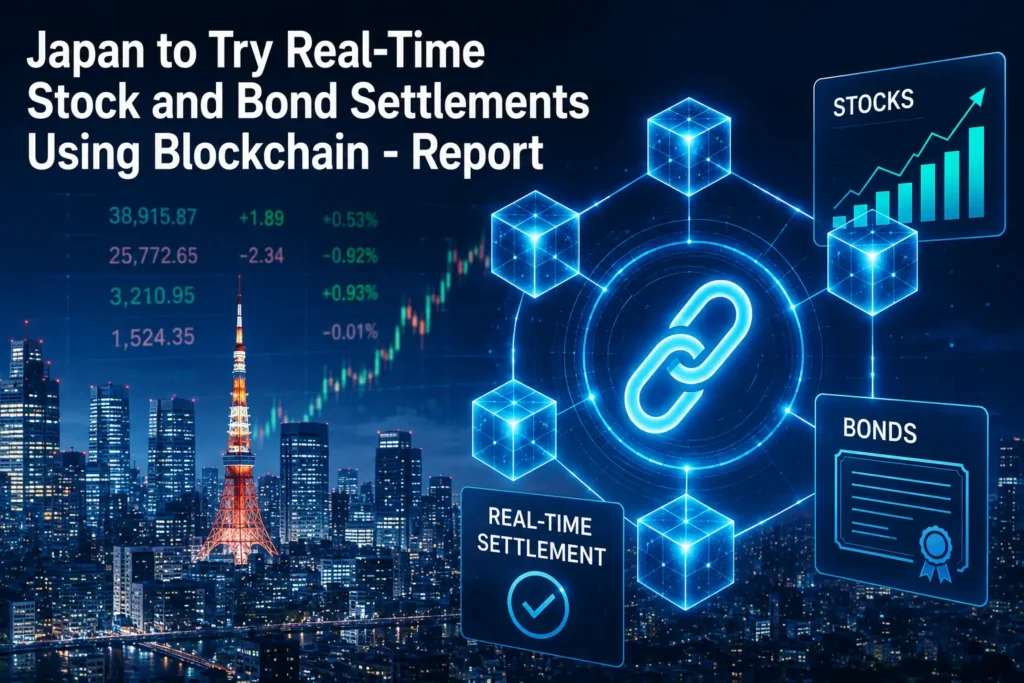
For decades, settling stocks and a piece of Japanese Government Bonds (JGBs) meant waiting. The wait time has certainly come a long way over time. Before 1997, bonds settled on fixed dates, and settlement has been T+1 (trade date + 1) since May 2018. But the Japanese government and the Bank of Japan (BOJ) are now set to further reduce wait times and pursue real-time stock and bond settlements using blockchain technology.
Nikkei Asia recently reported that the project aims to enable instantaneous settlement of stocks and JGBs at any time of day.
Many organizations, including the Ministry of Finance, the Financial Services Agency, the Bank of Japan, and others, could come together to develop a plan, which will include designing the blockchain, distributing accountability and responsibilities, and discussing future work. If everything goes through as planned, the project could go live in the early 2030s.
Initially, the project will convert a few current accounts held with the Bank of Japan to tokens (digital currency). These tokens will be circulated on the designed blockchain.
If Japan could pull this off, it would significantly reduce settlement time. The settlement for Japanese stocks before July 16, 2019, was T+3 (trade date + 3). This means that if you sell an equity stock today, settlement will take three more days. This was brought down to T+2 after July 16, 2019.
JGBs, on the other hand, started with fixed-date settlements before April 1997. They were then reduced to T+3, T+2, and T+1 for outright, domestic settlements from April 1997, April 2012, and May 2018, respectively. Cross-border settlements via International Central Securities Depositaries (ICSDs) still have a T+2 period.
While international settlement might still take time, domestic settlements would become instantaneous, as blockchain will bring 24/7 access and real-time verification into the picture for settlement of stocks and bonds.
The Japanese government ain’t the only one trying this, though. The private sector is already testing pieces of this future. In April, 2026, the Japan Securities Clearing Corp. began a trial with Mizuho, Nomura, and Digital Asset to explore using Japanese government bonds as blockchain-based collateral.
The project will determine, from both legal and practical perspectives, whether blockchain technology can be used to smoothly transfer rights and update book-entry transfer records within a hierarchical structure involving multiple account management institutions.
Nomura wrote in a press release.
The country’s three largest banks, Mizuho, MUFG, and SMBC, are also working on a joint stablecoin pilot. Under this project, the banks will issue a stablecoin under a trust agreement. The three banks will act as settlors.
There are many similar projects under progress worldwide. The question, however, is why only blockchain?
Blockchain in the stock market: How the technology fixes the settlement gap
The current settlement system runs through separate ledgers. And this isn’t the story of Japan alone. There are stock exchange records on who owns what. Then there’s a central securities depository that confirms transfers and a payment system that moves the cash.
Each of these ledgers reconciles with the others in batches. Thus, verification, accurate information transfer, and the chain of hands-off create the delay.
Blockchain fixes this by combining the different layers into a single decentralized ledger. Blockchain is renowned for its tamper resistance and transparency. Therefore, multiple authorized parties can simultaneously see and trust the information to mitigate delays.
There are two specific features that make blockchain useful for real-time stocks and bonds settlement:
- Smart contracts: A blockchain smart contract is a self-executing computer program. This means that when a predefined rule is met, it will automatically trigger and enforce some action. In the stock market, this process can automatically enforce delivery versus payment. Thus, with a smart contract in place, securities will only exchange hands when multiple parties confirm a matching payment on the decentralized ledger, and vice versa.
- Single source of truth: Instead of each constitution keeping its own records and then reconciling for settlement, all authorized parties can read from the same ledger in real-time.
These are the two key reasons why governments and organizations would continue to turn to blockchain for real-time settlement of stocks and bonds. It’s not that a conventional database cannot improve process speed, but it can’t natively solve the trust problem between different parties. A decentralized ledger with cryptographic verification solves this trust issue based on effective protocols.
Japan Isn’t Racing Alone
Japan’s move is a competitive one and not a solitary bet. While it is the first to try to implement it in stock market settlements, central banks and market infrastructures worldwide are converging on similar experiments.
The United States of America has already moved first on speed. Although not backed by blockchain technology, the country has compressed its equities to one-day settlement in 2024.
The US Securities and Exchange Commission (SEC) has authorized Wall Street’s central clearing utility, the Depository Trust & Clearing Corporation (DTCC), to tokenize traditional securities. This includes Russell 1000, major index ETFs, and U.S. Treasury bills, notes, and bonds. These tokenized digital representations carry the same legal rights and safeguards as the originals.
Europe has its own dual-track program through the European Central Bank. The Eurosystem’s short-term track, called Pontes, aims to pilot a link between Distributed Ledger Technology (DLT) platforms and its TARGET payment services by the end of 2026. There’s another longer-term track called Appia. It will aim to shape a more integrated, future-ready financial ecosystem.
Fellow Asian countries like Hong Kong and Singapore are also performing trials for cross-institution use. The HSBC bank completed a cross-bank transaction moving 3.8 million Hong Kong dollars for Ant International in real time. It used programmable bank deposits that enable 24/7 settlement while maintaining traditional supervision. Singapore, on the other hand, continues Project Guardian tokenized deposit trials alongside its own wholesale central bank digital currency work.
Currently, Japan’s plan is still just a plan. The country has not selected any blockchain or legal framework. Even the date stretches into the 2030s. However, it is unmistakably in the right direction. Japan is moving in step with the U.S., European countries, and many other nations worldwide that are racing towards faster bond and stock settlement using blockchain. Thus, blockchain technology will play a significant role in shaping the future of the stock market and the financial sector overall.