IoT Explained: What It Actually Means When Everything Is “Smart”

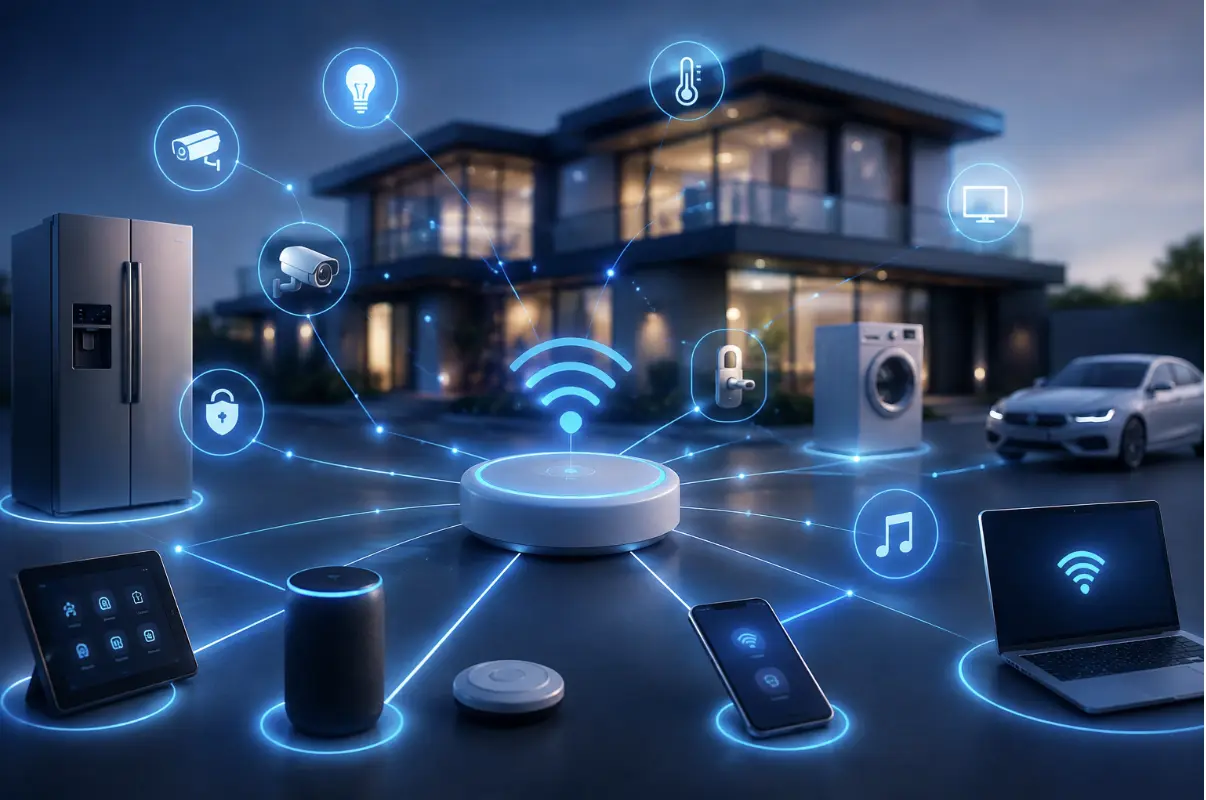
Your fridge probably knows more about your grocery habits than your spouse does. Your thermostat has opinions about when you get home. Somewhere in your house, a doorbell is quietly logging every person who walks past it. None of this is science fiction anymore. It’s the Internet of Things, and it’s already sitting in your living room whether you asked for it or not.
The term gets thrown around so casually that most people nod along without really knowing what it means. Is it just Wi-Fi-connected gadgets? Is it the same thing as AI? Why does every product box suddenly say “smart” on it? This article breaks down what IoT actually is, how it works under the hood, where it’s already running your life, and why the security conversation around it matters more than most people realize.
So What Does “Internet of Things” Actually Mean?
Strip away the marketing language and IoT is a simple idea: physical objects like thermostats, cars, factory equipment, streetlights, and even cows (yes, really) fitted with sensors and chips that let them collect data and talk to each other over the internet, usually without a person tapping a screen to make it happen.
The “thing” in Internet of Things can be almost anything. A smart plug is a thing. A shipping container with a location tracker is a thing. A pacemaker that reports your heart rhythm to a doctor’s office overnight is a thing. What makes it “IoT” isn’t the object. Instead, it’s the fact that the object can sense something about the world, send that data somewhere, and often act on it without waiting for a human to type a command.
This is different from a regular computer or smartphone. Your laptop is built to run any software you throw at it. An IoT device usually does one job. For example, measure temperature, track a location, or detect motion. And does it constantly, in the background, for as long as it’s powered on.
The Three Layers That Make It Work
Every IoT setup, no matter how simple or complex, is built from three layers stacked on top of each other.
- The sensing layer is the hardware itself. It is the actual sensor or chip that measures something physical. Temperature, humidity, motion, light, pressure, location. This is the part bolted onto the “thing.”
- The connectivity layer is how that data gets from the device to somewhere useful. This might be Wi-Fi, Bluetooth, a cellular connection, or increasingly, low-power protocols built specifically for IoT. Bluetooth alone accounts for roughly a quarter of all connected IoT devices worldwide, largely because it sips battery power compared to Wi-Fi.
- The processing layer is where the data actually gets turned into something useful. This is either in the cloud, on a nearby server, or increasingly right on the device itself through what’s called edge computing. A smart camera that decides “that’s a package, not a person” without sending footage to a data center first is doing edge processing.
Why Your Devices Don’t Always Talk to Each Other
If you’ve ever bought a smart bulb that refused to work with your existing smart speaker, you’ve run into IoT’s biggest practical headache: fragmentation. For years, every manufacturer built its own walled garden. A bulb from one brand spoke a different language than a plug from another, and getting them to cooperate meant relying on a third-party hub or just accepting that some devices would live in their own separate app forever.
Matter, a connectivity standard backed by Amazon, Apple, Google, and Samsung among others, was built specifically to fix this by giving manufacturers a shared language devices can use regardless of brand. It’s still working through growing pains, but it’s slowly becoming the reason newer smart home products are less likely to lock you into one ecosystem than they were even a couple of years ago. This matters more than it sounds. Interoperability is often the difference between a smart home that actually saves time and one that just adds more apps to manage.
Where You’re Already Using IoT (Whether You Notice or Not)
Most people picture smart speakers and video doorbells when they hear “IoT,” but the category is far wider than the gadgets marketed with that label.
Inside the Home
Smart thermostats that learn your schedule, robot vacuums that map your floor plan, video doorbells, leak detectors under the sink, smart locks, these are the visible face of IoT. The average American household now runs 21 connected IoT devices, up from just 15 two years ago, and that number keeps climbing as more everyday appliances ship with connectivity built in by default rather than as an add-on.
On Your Body
Fitness trackers, smartwatches, continuous glucose monitors, and hearing aids that adjust themselves based on the room you’re in are all wearable IoT. These devices are notable because they generate a steady stream of personal health data, which is part of why the wearables category gets singled out in privacy conversations more than almost any other type of connected device.
The Bigger Picture: IoT Outside Your Living Room
Consumer gadgets are the part people see, but the more consequential IoT deployments are happening in industries most people never think about.
Manufacturing and Predictive Maintenance
Factories use sensor networks to monitor machinery in real time, catching a failing bearing or an overheating motor before it causes a shutdown. This is called predictive maintenance, and the results have been significant enough that manufacturers like Siemens have reported cutting equipment downtime by as much as half after deploying sensor-driven monitoring across production lines.
The logic here is straightforward once you strip away the industrial jargon: a factory machine that’s about to fail usually shows warning signs first. For instance, a slight temperature increase, a change in vibration pattern, a small drop in output speed. Human inspectors used to catch these signs occasionally, during scheduled checks. Sensors catch them constantly, which is why predictive maintenance has become one of the fastest-adopted forms of industrial IoT rather than staying a niche pilot program. Industrial IoT as a category is now the single largest segment of the entire IoT market, ahead of consumer smart-home products by a wide margin, which says a lot about where the real money and the real impact are concentrated.
Healthcare
Hospitals are increasingly relying on connected equipment. For instance, infusion pumps that report dosage in real time, monitors that alert nurses before a patient’s vitals cross a dangerous threshold, and remote monitoring tools that let doctors track chronically ill patients without an office visit. Medical facilities are projected to be running roughly 7.4 million IoT devices, a number that keeps rising as remote patient monitoring becomes standard practice rather than an experimental program.
Smart Cities
Traffic lights that adjust timing based on real-time congestion, streetlights that dim when no one’s around, water systems that detect leaks before they become sinkholes. This is how cities are quietly becoming IoT networks at municipal scale. Seoul is often cited as a leading example, using a citywide public Wi-Fi network paired with AI-driven traffic systems to smooth congestion in real time rather than relying on fixed light timers.
Agriculture
Soil moisture sensors, livestock trackers, and automated irrigation systems let farms respond to conditions field by field instead of guessing. This kind of precision agriculture is one of the quieter IoT success stories, mostly because it doesn’t come with a flashy consumer product attached to it.
The Numbers Behind the Hype
It’s easy to assume “IoT” is still a buzzword in progress, but the scale involved is already enormous. Global IoT connections are projected to cross 21.9 billion in 2026, more connected devices than there are people on the planet by a wide margin. The market attached to all of that hardware, software, and services is expected to surpass $1.1 trillion this year, with industrial applications (factories, logistics, agriculture) making up the largest single slice of that spending rather than consumer smart-home products.
Analysts at IoT Analytics project the device count will keep climbing past 39 billion by 2030, more than doubling today’s installed base within the decade. That growth isn’t just about more smart speakers being sold. Rather, it reflects entire industries rebuilding their operations around constant, automated sensor data instead of periodic manual checks.
Why “Smart” Doesn’t Always Mean Safe
Here’s the part that rarely makes it onto the product packaging: every connected device is also a potential entry point into a network. A smart thermostat doesn’t need bank-grade security. So many manufacturers don’t build it in. And that weak link can end up being the way someone gets into a home network that also has a laptop full of financial information sitting on it.
This isn’t a hypothetical concern. Researchers tracking IoT security incidents recorded over 9 billion security events across roughly 50 million devices in a single study period, a scale that reflects just how attractive poorly secured smart devices have become as targets. The industry’s own advisory groups have flagged this directly, noting that a major theme for 2026 is enterprises finally being forced to account for “dark assets” – the pile of disconnected, outdated, or forgotten smart devices sitting on corporate networks with no oversight at all.
For everyday users, the practical takeaway is straightforward: change default passwords, keep device firmware updated, and think twice about which gadgets actually need to be internet-connected in the first place. Not everything benefits from being “smart.”
Network providers are also starting to treat this as core infrastructure rather than an afterthought. Some of the larger telecom players now market zero-trust security models specifically built around IoT deployments. This approach treats every connected device as untrusted by default until it proves otherwise, rather than assuming anything inside a company’s network is automatically safe. That shift matters because the old assumption, that a firewall around the edge of a network was enough protection, breaks down completely once thousands of individually hackable sensors are sitting inside that perimeter.
Wrapping It Up
IoT isn’t a single product or a passing trend. It’s the quiet infrastructure running underneath a huge share of modern life, from the thermostat on your wall to the sensors keeping a factory line running. Understanding what it actually is makes it easier to see through the “smart” label slapped on everything and ask a more useful question: does this device genuinely need to be connected, and what happens to the data it collects once it is?
As more of the physical world gets wired up, that question is only going to matter more, not less. The technology isn’t slowing down, but a little skepticism about which gadgets deserve a spot on your network goes a long way.
Frequently Asked Questions
Is IoT the same thing as smart home technology?
No. Smart home devices are just one category within IoT. The broader term also covers industrial sensors, connected medical equipment, agricultural monitoring, wearable tech, and infrastructure like traffic systems, none of which involve a home at all.
Do IoT devices need Wi-Fi to work?
Not always. Many rely on Bluetooth, cellular connections, or low-power protocols like Zigbee and Z-Wave that are built specifically for small, battery-powered devices rather than general internet browsing.
Who actually owns the data an IoT device collects?
This varies by manufacturer and is usually buried in the terms of service. In many cases, the company that made the device retains rights to the data it collects, which is why reading privacy policies for smart devices matters more than people tend to assume.
Can IoT devices work without an internet connection at all?
Some can function locally on a home network using protocols like Thread or Matter, letting devices talk to each other and to a hub without sending data out to the cloud, though many still require an initial internet connection for setup and updates.