Machine Learning Myths: What AI Can (and Can’t) Actually Do

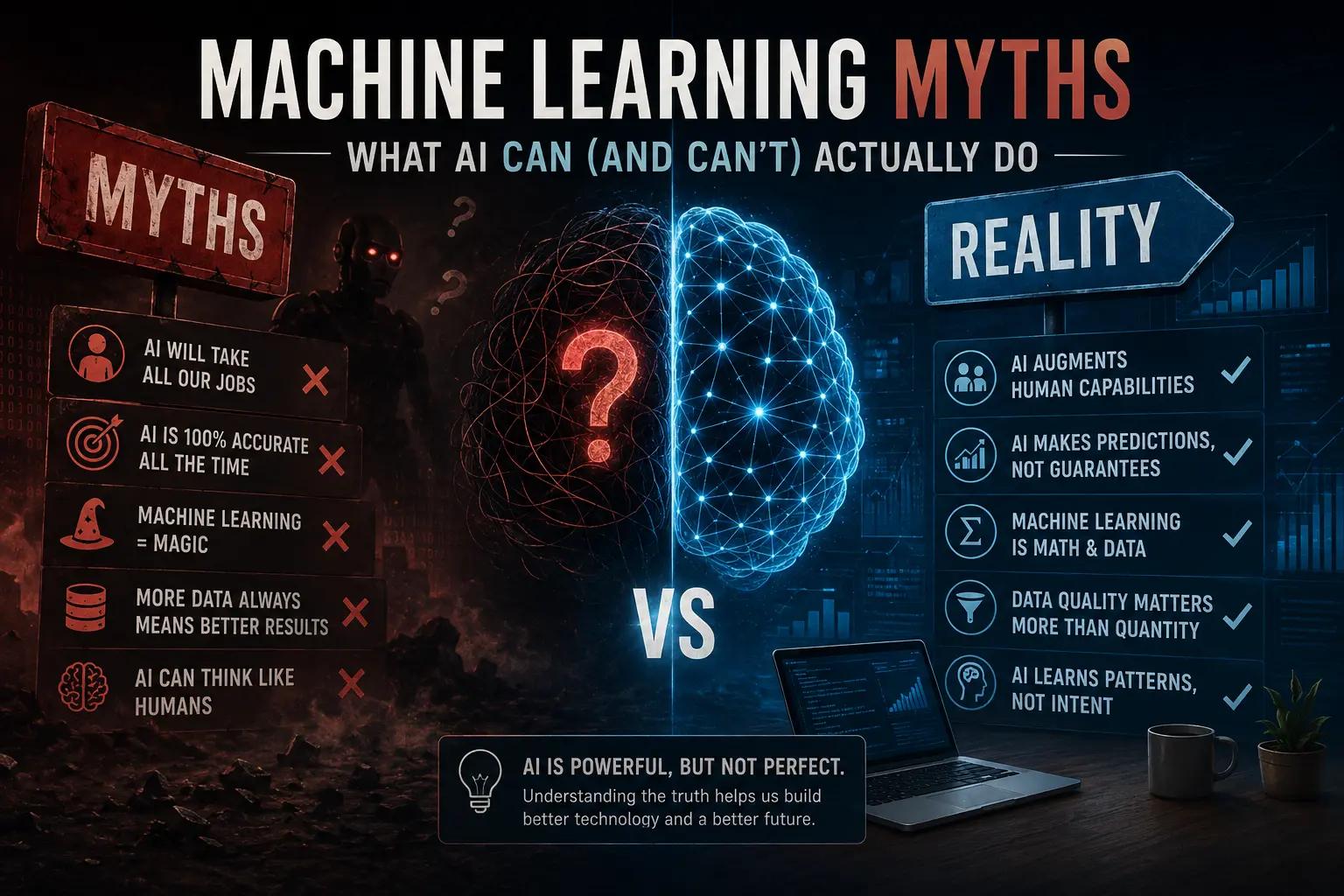
Artificial intelligence has gone from a niche engineering topic to dinner-table conversation in the span of a few years. Everyone has an opinion on it. Some think it’s on the verge of thinking for itself, others dismiss it as an overhyped autocomplete. Both camps are working off myths, not facts.
The truth about machine learning sits in a much less dramatic middle ground. It’s a genuinely powerful technology that is also narrower, more fragile, and more human-dependent than most headlines suggest. Understanding where the real edges are (not the sci-fi version, or the marketing version) is the only way to actually use this technology well, whether you’re a business leader deciding where to invest or just someone trying to make sense of the news cycle.
Here are the most persistent myths about AI and machine learning, and what’s actually true.
Myth #1: AI “Understands” What It’s Doing
This is probably the most common misconception, and it’s an easy one to fall into. Conversational AI tools are designed to sound confident, coherent, and even empathetic. When a chatbot apologizes for a mistake or explains a concept clearly, it’s natural to assume there’s some kind of comprehension happening behind the words.
There isn’t, at least not in the way humans understand the term. Large language models work by processing enormous datasets and learning statistical patterns in how words, images, or other data relate to each other.
When an AI model responds to a prompt, it’s essentially predicting the most probable next piece of information based on patterns it has seen before. It’s not reasoning through the problem the way a person would. Model outputs don’t reflect a system that “knows” what it’s saying; the reasoning-like structure is a byproduct of training, not genuine understanding.
That distinction matters because it explains AI’s most well-documented weakness: hallucination, where a model generates information that sounds plausible but is factually wrong. It’s not “lying,” and it’s not “confused” but producing statistically likely text without any built-in mechanism to verify truth.
Even leaders at the frontier of AI development acknowledge this gap openly.
“You can easily, within a few minutes, find some obvious flaws with [AI chatbots] — some high school math thing that it doesn’t solve, some basic game it can’t play,” said Hassabis. “It’s not very difficult to find those holes in the system,” said Google DeepMind CEO Demis Hassabis.
Myth #2: AI Learns and Improves on Its Own
There’s a persistent idea that once you deploy an AI system, it just keeps getting smarter by itself, learning from every interaction like a human employee gaining experience. In most real-world deployments, this isn’t how it works at all.
The AI models people interact with daily, like chatbots, recommendation engines, or image generators, are typically static once deployed. They don’t continuously retrain themselves on live conversations.
Improving them requires deliberate human effort: curating new training data, retraining or fine-tuning the model, and testing the results before redeployment. Even the “personalization” that makes an AI assistant feel like it remembers you is usually a separate memory or context system bolted on top of the core model, not the model itself evolving.
This has real consequences. It means AI systems can’t automatically self-correct when their information goes stale, and it means “AI will figure it out on its own over time” is not a viable strategy for most businesses deploying these tools.
Myth #3: AI Is Objective and Bias-Free
Because AI systems run on math and data rather than human emotion, there’s an assumption that their outputs are inherently neutral. In reality, AI models are only as unbiased as the data they were trained on. And real-world data is full of historical and social biases.
This isn’t a theoretical concern. AI hiring tools have been shown to replicate gender and racial bias present in historical hiring data. Facial recognition systems have documented higher error rates for darker-skinned faces. Credit-scoring and risk-assessment algorithms have faced scrutiny for encoding the same disparities found in the financial data they were trained on.
None of this happens because the AI is “prejudiced.” It happens because the model is pattern-matching against a world that already contains those patterns.
This is also why more organizations are treating AI risk management as a governance issue rather than a purely technical one. McKinsey’s 2026 AI Trust Maturity Survey found that as adoption accelerates, organizations increasingly have to contend not just with AI systems producing wrong information, but with autonomous “agentic” systems taking unintended actions. This raises the stakes on getting oversight right.
Yoshua Bengio, one of the so-called “godfathers of AI” and a Turing Award winner, has made a similar point about failure modes going unnoticed:
“We’re not paying attention to these failure modes. And that could have catastrophic impact on our societies.”
His warning was aimed at more advanced risks, but the underlying point applies just as well here. Bias and error in AI systems tend to go unaddressed precisely when nobody is watching for them closely enough.
Myth #4: More AI Investment Automatically Means Better Results
There’s a widespread assumption that adopting AI is itself the win and that simply plugging generative AI or an AI agent into a workflow will translate into measurable business value. The data tells a very different story.
According to McKinsey’s State of AI research, 88% of surveyed organizations now regularly use AI in at least one business function, and 72% report using generative AI specifically, signalling a sharp rise from previous years. But usage and value are not the same thing.
Research from MIT’s Project NANDA found that roughly 95% of enterprise generative AI pilots fail to deliver measurable financial impact, with only about 5% of projects creating measurable value.
McKinsey’s own numbers echo this: only about 39% of organizations report any EBIT impact attributable to AI at the enterprise level, and just 6% qualify as “AI high performers” attributing more than 5% of EBIT to AI.
The gap, according to MIT’s researchers, isn’t primarily a technology problem. As they put it, the divide between organizations that succeed with AI and those that don’t does not seem to be driven by model quality or regulation, but seems to be determined by approach. In plain terms: how a business integrates AI into real workflows matters far more than which model it buys.
Myth #5: AI Is Going to Replace Human Jobs Entirely
This might be the most emotionally loaded myth, and it deserves a careful answer rather than a dismissive one. Job disruption from AI is real and shouldn’t be minimized. But “replacement” and “disruption” are not the same thing.
Most labor economists and industry researchers describe the near-term effect of AI as augmentation and task-shifting rather than wholesale job elimination. Roles change, specific tasks within jobs get automated, and new categories of work emerge. However, full occupational replacement across the economy has consistently been slower and messier than predicted.
McKinsey’s State of Organizations 2026 survey found that when leaders were asked how they expect AI to change their workforce over the next one to two years, most expect it to act mainly as a support tool in the near term, with younger leaders somewhat more optimistic about AI taking on more autonomous roles.
The realistic takeaway: certain tasks, especially repetitive, data-heavy, or pattern-based ones, are genuinely at risk of automation. But broad claims that “AI will replace your job” oversimplify a much more gradual and uneven process of workplace change.
What AI Can Actually Do Well
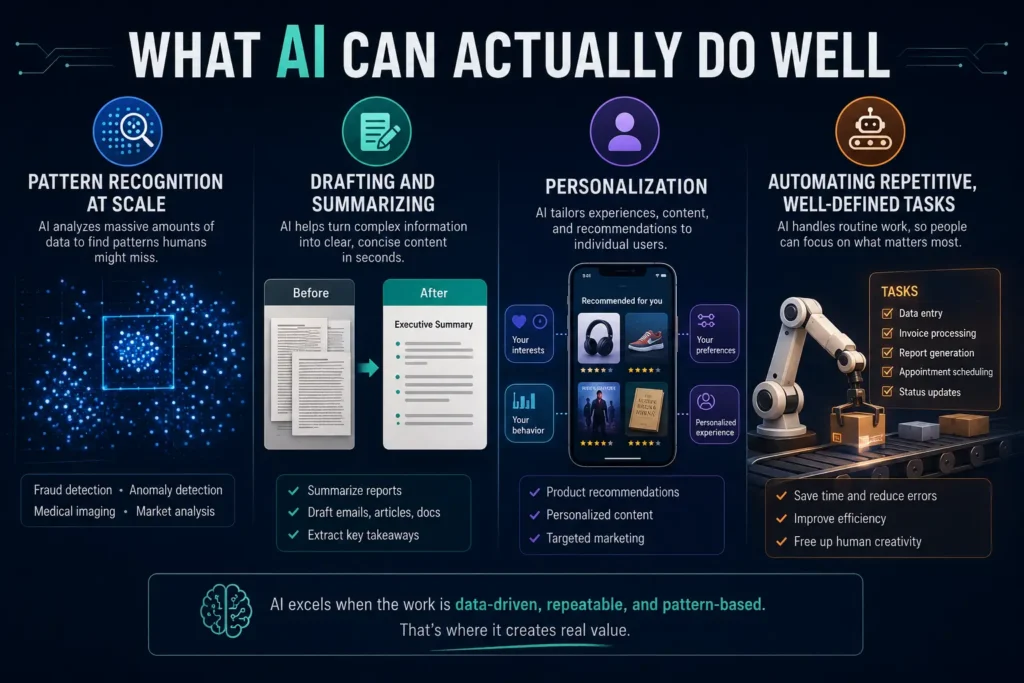
None of this is meant to write AI off. Despite the myths, machine learning genuinely excels at specific things:
- Pattern recognition at scale: spotting fraud signals, image features, or trends across datasets far larger than any human could manually review.
- Drafting and summarizing: producing first-draft text, code, or summaries quickly, provided a human reviews and refines the output.
- Personalization: powering recommendation systems that adapt to user behavior across shopping, streaming, and search.
- Automating repetitive, well-defined tasks: data entry, basic customer service queries, scheduling, and similar structured work.
The pattern across all of these strengths is consistency: AI performs best on narrow, well-defined tasks with clear success criteria and human oversight and not open-ended judgment calls.
The Bottom Line
The most useful way to think about AI isn’t “magic” or “hype.” It’s a powerful but limited tool that requires human judgment, review, and context to work well. Businesses and individuals who treat AI as an infallible replacement for human decision-making tend to get burned.
Those who treat it as a well-defined, well-supervised tool tend to get real value out of it. As AI systems get more capable and more autonomous that gap between hype and reality is only going to matter more, not less.
FAQ
- Does AI actually “think” like a human brain?
No. AI models, including large language models, generate outputs by identifying statistical patterns in training data rather than reasoning or understanding in a human sense. The results can look thoughtful, but the underlying process is fundamentally different from human cognition.
- Why does AI sometimes give confidently wrong answers?
This is called hallucination. Because AI models generate the most statistically likely response rather than verified facts, they can produce incorrect information while sounding completely certain. This is why human review remains important for any AI-generated content used in decision-making.
- Can AI models improve automatically over time without human input?
Generally, no. Most deployed AI models are static after training and require deliberate human effort like new data, retraining, fine-tuning, and testing to improve. They don’t “learn” continuously from everyday use the way a human employee gains experience.
- Is AI bias a solvable problem?
It’s manageable, not fully solvable in an absolute sense. Because AI models learn from historical data, they can reflect and even amplify existing societal biases. Careful data curation, testing, and ongoing monitoring can reduce bias significantly, but it requires continuous effort rather than a one-time fix.
- Will AI eliminate most jobs in the near future?
Most current evidence points toward task-level automation and job transformation rather than mass, wholesale job elimination in the short term. Certain repetitive or data-heavy tasks are more exposed to automation, while jobs requiring judgment, creativity, and interpersonal skills are comparatively more resilient. At least for now.