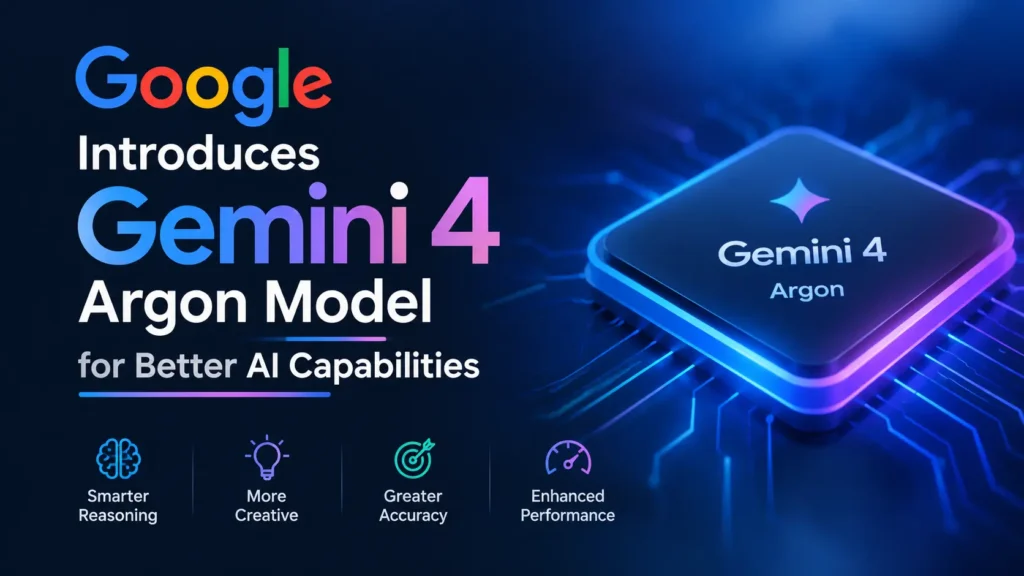
Google Introduces Gemini 4 Argon Model for Better AI Capabilities

OpenAI brought generative AI to the general public in November 2022 with ChatGPT. Google followed suit with Gemini in December 2023. However, when it comes to mass use, they differ significantly. Some reports claim ChatGPT has around 1.2 billion weekly active users, while Gemini reached 1 billion active monthly users in August 2026. To bridge this gap and help Gemini deliver frontier performance on complex tasks, Google released Gemini 4 Argon on September 30, 2026.
Google Announces Gemini 4 Argon
Gemini 4 Argon is a new generative AI model with significantly higher input and output token limits for advanced workflows. Both limits have been increased to 1 million. With a high token limit, the model can think deeply and generate more contextual tokens in a single go. This provides the depth and reasoning required for complex tasks. And this has been reflected in initial screenings, too.
According to Google’s own industry review, the model outperforms current benchmarks, especially across knowledge work, long context, multimodal understanding, and cybersecurity.
Google is, however, rolling out the new model in phases. So who can use Google Gemini 4 Argon right now? For now, the company has rolled it out only to a select few cyber defenders in its Fairwind Program.
The Fairwind Program is a limited-access initiative by Google that gives government agencies, trusted enterprise partners, and critical infrastructure operators early access to new advanced AI models.
The aim is to offer access without many cybersecurity guardrails, so they can understand the loopholes in each model. Based on the feedback received, engineers then iterate on the model to make it more resilient to modern-day cybersecurity attacks and mitigate potential loopholes.
The company is actively working with the government’s voluntary pre-release model access process to gradually expand access.
Pricing will be $2 per million input tokens and $10 per million output tokens during the introductory phase. After that, the cost will increase to $4 per 1M input tokens and $20 per 1M output tokens.
Safeguards Google Is Working on for the New Model
Before rolling out Gemini 4 Argon’s access to everyone, Google is trying to identify what safety guardrails to add to the model.
- Defending against misuse: Argon is built to refuse harmful requests, such as those enabling cyber or CBRN attacks, while still supporting legitimate dual-use scientific research. For this launch, the safeguards were strengthened, including better monitoring of the model’s internal activations to detect misuse. Internal and external red teams tested it using manual and automated attacks.
- Defending against prompt injection: Argon is described as the most resilient model yet against indirect prompt injections, where malicious instructions hijack a model’s behavior. Automated red teaming and adversarial training back this up, and it leads on Gray Swan’s Indirect Prompt Injection benchmark.
- Monitoring for misalignment: Mitigations watch Argon’s chain-of-thought and actions and halt execution if it goes beyond what the user intended. A similar system monitored training runs and alerted an incident response team. Findings were deliberately kept out of training so the model’s reasoning isn’t shaped to evade monitoring. The team also urges the wider industry to preserve reasoning transparency so model thoughts stay useful for diagnosing misalignment.
- Hardening systems: As models become more capable, testing them requires more secure environments. Sandboxes are being isolated and sealed before high-risk training or evaluations begin, in line with their agent control roadmap. They plan to share these agent security best practices with partners to strengthen security across the ecosystem.
Gemini 4 Argon marks Google’s push to close the quality and output gap with leading generative AI models. It pairs 1 million token limits and strong benchmark results with a cautious, phased rollout that currently reaches only select cyber defenders through the Fairwind Program. Once access widens, we’ll see whether performance and protection together are enough to challenge ChatGPT’s lead.