Agentic AI Vs. AI Agents: Key Differences Between the Two Terms Explained

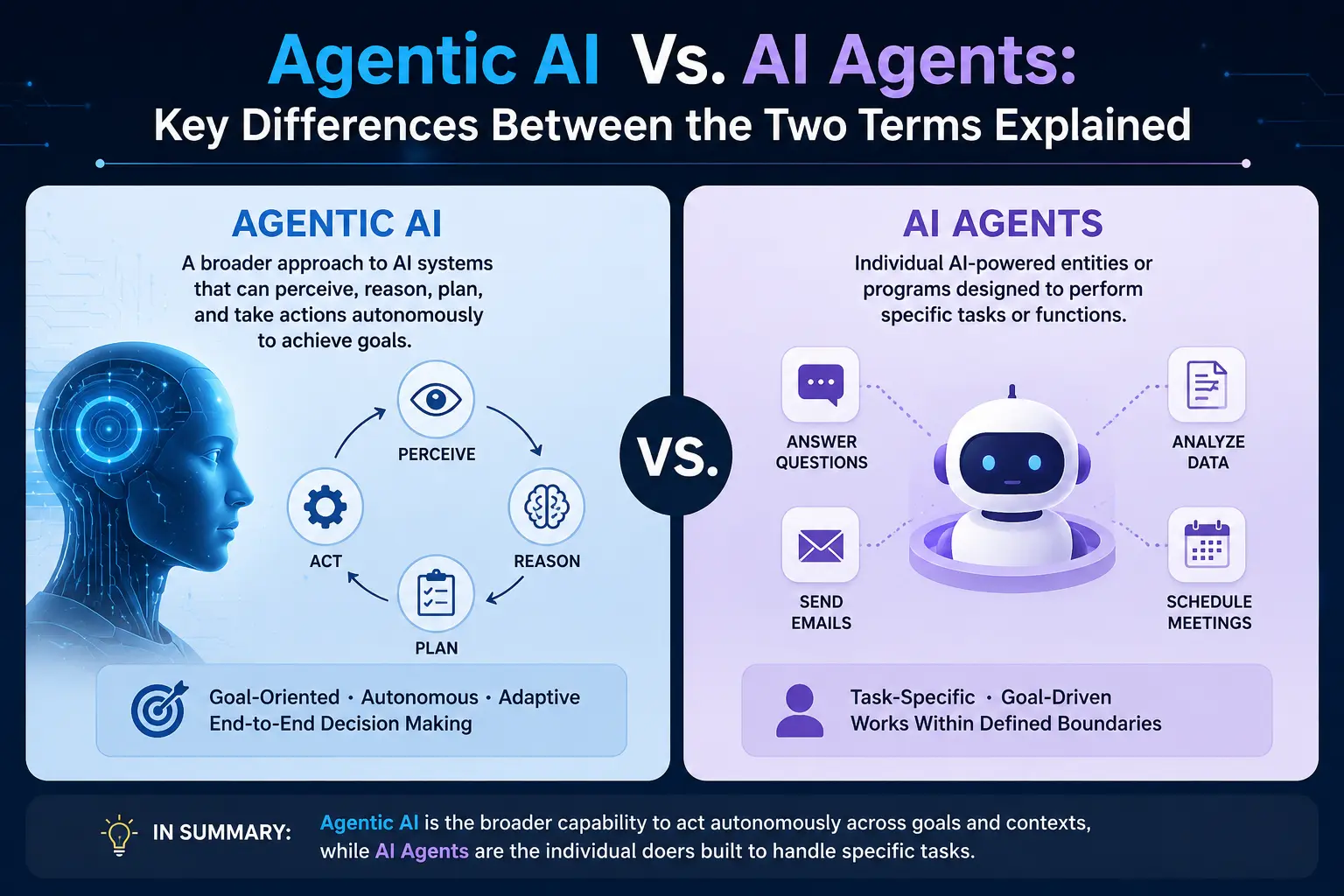
Advancements in artificial intelligence (AI) have also evolved the terminology around it. If you have spent any time reading about the technology recently, you would have likely heard the terms “AI agents” and “agentic AI.” Although used interchangeably in broader contexts, there are many differences between agentic AI vs. AI agents, from how they work to their decision-making workflows.
Both of them refer to artificial intelligence systems that can work through multiple steps without human intervention. But understanding the underlying differences is important to decide which one is more useful for reaching your goals.
What Are AI Agents?
AI agents are AI systems that use available tools to perform multiple tasks autonomously. They can act on behalf of a user or a computer system by leveraging capabilities such as interacting with external tools, making decisions, and solving problems. Thus, they are capable of completing complex tasks, which include code generation and software design.
What powers them primarily is the multimodal capacity of generative AI. Similar to generative AI, these systems can process voice, video, text, code, and much more. As they progress, they can learn over time to improve outputs.
Consider an example where you are a busy C-level executive who does not have enough time to respond to every email in your inbox. Here, an artificial intelligence agent can become an email assistant. The agent can monitor and read emails to identify those that require a response based on the criteria you set. Similarly, suppose an email includes an online meeting request. In that case, the agent can connect with your calendar, check availability, pick a time, and wait for you to confirm the details before replying.
It is these capabilities of AI agents that make it lucrative for businesses of all sizes. A McKinsey & Company report notes that 62% of the respondents said that their organizations have either started using AI agents or experimenting with them.
How Do AI Agents Work?
At the very base, every AI agent follows a four-step process to complete a task it is assigned.
- Understanding the task: Once you assign a task to an agent, it starts leveraging the gen AI capabilities to understand it.
- Planning: The agent will then dissect the task and plan how to proceed. While this planning is not always necessary in smaller tasks, complex problems require it for efficiency, which, according to the McKinsey & Company report mentioned above, is the primary goal of 80% of the respondents.
- Act: A key difference between artificial intelligence agents and generative AI is that the latter relies solely on its limited knowledge base and training data to produce outputs. But unlike that, agents can rely on other available tools, such as APIs, web searches, and external databases, to gather information to complete the task assigned. After gathering all the information and planning, the agent acts to complete the task assigned.
- Observe & Learn: As mentioned earlier, AI agents can learn and improve on their own. Therefore, they observe the output and receive feedback on it. Then, they can adjust their future outputs based on user preferences,
Types of AI Agents
There’s no single standard to distinguish AI agents into types. They can be categorized based on their goals, interaction, and simplicity. Learning about these different types matters because they shape decisions. Since they are designed for different purposes, they shape how the underlying AI models make decisions or how much knowledge they retain.
Listed below are some common types you should know about:
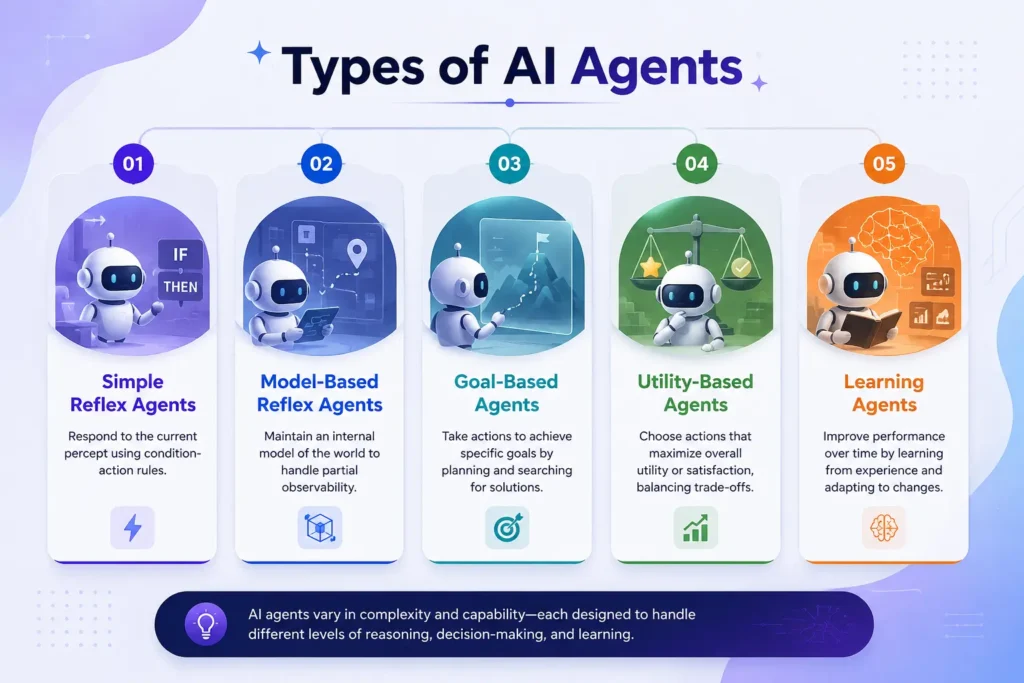
Simple Reflex Agents
They are the most basic form of AI agents that operate only on predefined rules and information. Thus, they don’t interact with any other tool or retain any knowledge. Basically, they work on actions that are invoked only when some predefined conditions are met.
A simple example of this type is a motion-sensor light. It turns on when motion is detected, and vice versa. The agent in such a simple smart light will only use the current input and not rely on historical data or predict future outcomes.
Model-Based Reflex Agents
These are similar to simple reflex agents but with a much more advanced decision-making mechanism. Instead of relying on predefined rules, model-based reflex agents use their current understanding and memory to create an internal model of the world they perceive. Then, they rely on that model to support their decisions. With every outcome, these agents continue to receive more information and update the internal model accordingly.
An advanced robot vacuum is an ideal example of this type of agent. The vacuum will remember which areas it has already cleaned and avoid cleaning them twice. It will also detect obstacles and build a basic map of the room to navigate it, rather than relying solely on the current sensor data.
Goal-Based Agents
As the name suggests, the primary focus of these agents is to reach their goals. They plan different routes to reach the goal and then decide which one is the most effective.
Consider a navigation system that a user uses to travel from Point A to Point B. Here, the AI agent will plan multiple routes through a combination of different streets and turns to reach Point B. Once it finds the best route, it will show the output so the user can make the final decision.
Utility-Based Agents
Utility-based agents have a more robust reasoning model than that of goal-based agents. Besides reaching the goal, these agents can calculate which path will be the most lucrative for you. They calculate utility, which can be referred to as the happiness factor, for each decision. Based on that, it will make the most beneficial decision to reach a goal.
A ride-hailing platform such as Uber would have a perfect use case for such agents. Utility-based agents can help select the best driver to assign to a customer based on factors such as:
- Distance
- Estimated arrival time
- Traffic
- Driver ratings
- Pricing
Learning Agents
Unlike other agents, these are more focused on learning from outcomes or feedback. Every experience is added to the agent’s knowledge bank. As a result, it becomes increasingly effective at operating in unfamiliar environments.
Recommendation engines, such as those used by Netflix and Spotify, are good examples of this type of AI agent. They learn from your history of watching or listening and recommend new videos or audio to you.
What Is Agentic AI?
Most people think that agentic AI is simply a group of AI agents working together, but that’s nowhere near the truth. There can be hundreds of AI agents working in a single system, and still, it won’t be agentic AI. The difference lies in coordination. An infrastructure or a system is called agentic AI only when it allows multiple AI agents not just to work together, but to plan and execute tasks in collaboration.
Unlike AI agents that work under predefined tasks, agentic AI takes broader actions without human intervention. It can break complex tasks into subtasks and handle them simultaneously instead of keeping them in queues. It is agentic AI that gives agents the capabilities to plan, reason, and route effectively. The introduction of this system enables some key capabilities that AI agents may lack when working alone, which are:
- Goal-oriented reasoning
- Dynamic adaptation
- Multi-step planning
- Cross-system orchestration
Put simply, you can think of it as a teammate who can work tirelessly and learn continuously to adapt to your requirements and fulfill them. In fact, an MIT Sloan Management Review survey found that 76% of the respondents, comprising global executives, consider agentic AI as a coworker and not just a tool.
Key Differences Between Agentic AI Vs. AI Agents
For many, the only difference between AI agents and agentic AI lies in whether a single agent or a group of agents is used. However, the real distinction lies in workflows and orchestration. The table below lists how AI agents and agentic artificial intelligence differ across several factors.
| Factor | AI Agents | Agentic AI |
| Scope | Works on a single task at a time | Handles broader tasks simultaneously by breaking them into small tasks |
| Autonomy | Can act independently but only in steps and usually within shorter loops | Has the capability to plan and execute across longer loops without constant human intervention |
| Control and governance | Easier to govern because a single task boundary is simpler to audit and constrain | Requires layered guardrails, approval checkpoints, and monitoring |
| Reliability pattern | Failures are contained within a single task | Success is measured based only on end-to-end goals |
| Architecture | Single model and a defined toolset | Multi-agent orchestration for planning, decision-making, and sharing memory across multiple AI agents |
| Learning capabilities | It is limited because AI agents follow existing rules and do not adapt significantly | Learns from outcomes and adapts over time |
| Decision-making | Rule-based, usually predefined rules | Decision-making is proactive and based on an updated internal model environment |
| Memory | Limited to the current task | Keeps both short- and long-term memory updated to stay aligned with overall goals |
| Coordination | Can interact with multiple systems, but does not coordinate with them | Coordinates with multiple systems and AI agents through unified orchestration for centralized insights |
Why Do the Two Terms Get Conflated?
Agentic AI and AI agents are used interchangeably because many consider the former as just a vibe instead of a specification, and the line between the two is actually blurred, as it is not easy to define where the agent stops and agentic AI starts. Put simply, the meaning of the two terms can sometimes overlap, just like in the case of conversational AI vs. generative AI.
Many vendors have started to use agentic to define their chatbots, copilots, and other solutions. Even though the underlying system is just a scripted workflow, the word sits well with consumers. Also, if a single system is given enough tools, memory, and planning ability, it starts to look like an agentic system. Since there is no hard line, the agentic AI vs. AI agents difference can become blurred.
Real-World Examples of AI Agents and Agentic AI, and When to Use Each
Both AI agents and agentic AI are already becoming a regular part of our everyday lives. From customer support to recommending products, these systems are now capable of helping with many day-to-day life activities, and businesses are using that opportunity. In fact, AI agents are also used at the FIFA World Cup 2026.
Take, for example, customer support. When someone contacts a company’s customer support, there’s a good chance a chatbot will greet them on the other end. If this chatbot is powered by an AI agent, it could answer simple queries, but it will escalate any complex issues to a human support provider. However, agentic AI will understand the issue, make decisions without human support, and handle queries end-to-end.
“It’s an imperative that every organization have a strategy to deploy and utilize AI agents in customer-facing and internal use cases.”
Sinan Aral, professor at MIT Sloan
The same goes for something as complex as coding or software management. An AI agent can constantly monitor and analyze the code to detect any discrepancies. Put simply, it can act as a virtual assistant. However, if you want help with writing the code, then you will need help with agentic AI.
When deciding which one will be more useful, assess your requirements first. If your task is well-defined and the failure mode is contained, go with AI agents. They are easy to test, audit, and roll back. But if your project or everyday requirements require chaining many steps together, agentic AI will be the ideal solution.
Agentic AI can certainly be more useful, but you will need appropriate infrastructure, budget, and governance capabilities for that.
A multi-country Deloitte survey found that 80% of the companies that responded lacked governance capabilities to implement and successfully run agentic AI systems. The biggest hindrance was setting clear boundaries around which decisions agents can make independently and which require human approval.
Therefore, it is important to assess agentic AI readiness and then start small and slow. Once you have a system in place, you can scale it when your IT infrastructure is ready to handle the requirements.
Using Agentic AI and AI Agents With Other Technologies
Artificial intelligence agents and agentic AI can handle both simple and complex tasks independently. But the real value of technologies always comes from working together. There are endless examples to prove that. Smart manufacturing won’t be smart enough without Internet of Things (IoT) sensors to collect real-time data for AI models to analyze. Similarly, immersive environments created by augmented and virtual reality become more attractive when personalized to individual user preferences using artificial intelligence.
Agentic AI and AI agents can also work with other technologies for more effective outcomes.
AI Agents and Agentic AI + IoT
The key benefit of using IoT is that it can generate a constant stream of real-world data that can be fed to agentic AI. This can enhance the capability of both these technologies.
Consider an example of a smart manufacturing factory. Traditionally, IoT sensors would have picked up data on a machine’s temperature and vibration and sent it to AI. The artificial intelligence systems would have then predicted that the machine would fail in a few days. Because of the automated workflow, a notification would have been raised for the maintenance teams, who would then schedule maintenance, order replacement parts, and update the production schedule.
But now, with AI agents and agentic AI in the picture, the system can handle the end-to-end process. It will check the maintenance team’s availability and create a maintenance schedule. Besides that, it will also pick the right maintenance personnel to assign the task to based on skills and expertise. To add to that, it will order replacement parts, adjust the production schedule to minimize downtime, and inform relevant stakeholders, all without any human intervention.
Similarly, IoT and agentic AI can together improve:
- Predictive maintenance
- Smart cities and buildings
- Industrial automation
- Energy grids, etc.
AI Agents and Agentic AI + Blockchain
Besides IoT, AI agents and agentic AI can also work with blockchain, which offers them a verifiable, tamper-resistant record of what the autonomous system actually did. AI agents are already managing cryptocurrency wallets and running DeFi strategies. The introduction of blockchain makes every move trackable, and this tamper-proof data can also be used by AI agents to self-improve.
One of the biggest real-world examples of this comes from Coinbase’s January 2026 launch of Payments MCP. It connects large language models directly to a blockchain wallet via the Model Context Protocol. Thus, agents can check balances, send crypto, and interact with smart contracts.
Conclusion
Although used interchangeably, agentic AI and AI agents have a lot of differences. They differ in scope, memory, coordination, decision-making, and much more. Without understanding these key differentiations, implementing either of the two can prove challenging, especially if you have a specific goal in mind.
But despite the differences between agentic AI vs. AI agents, they are not competing technologies. They just have different approaches and scopes. Therefore, it is important to use them collectively in the best possible way, and that’s in a hybrid approach. But as the two converge, governance and risk management will take center stage.
Frequently Asked Questions
A standalone agent can be agentic but only up to a certain degree. Agentic describes a behavior in which a system can plan, decide, and act. A single standalone agent can exhibit this behavior and become agentic. The problem, though, is that it will become slow since it will be handling every task on its own. Additionally, agents are usually built to work on a specific task, which means that this agentic system will not be able to handle complex tasks accurately.
Some form of human oversight is required, regardless of how good an agentic AI is. It also requires guidance from researchers and practitioners to scale the solution. However, human oversight doesn’t have to be constant. It depends on how easy a task is to verify and how costly the mistake would be.
It is best to start with a single agent to ensure successful implementation. Once that implementation is successful, the number of agents can be added later to scale. You can then add an orchestration layer among these agents to allow them to communicate and coordinate with each other to make it agentic.
There are many daily use cases where AI agents and agentic AI can become useful. For instance, they can help with email spam filters, smart thermostats, navigation apps, chatbots, scheduling tools, and coding assistants.
Processing speed and error types can give away the difference between an AI agent and a human acting. AI agents can respond without any delay, while humans take time to process data and make decisions. Similarly, agentic AI, although good at storing memory, can sometimes forget past facts in an odd way. Humans, on the other hand, make emotional choices and basic errors, but can hold past memories.